Associations
Your Association Doesn't Need Another Platform
RallyBoard Co-founder and CEO, Jackson Boyar, argues that members do not want another platform; instead, they are seeking personalized, value-add programs

Jackson Boyar
Co-founder and CEO
Jan 13, 2026
·
8 min read
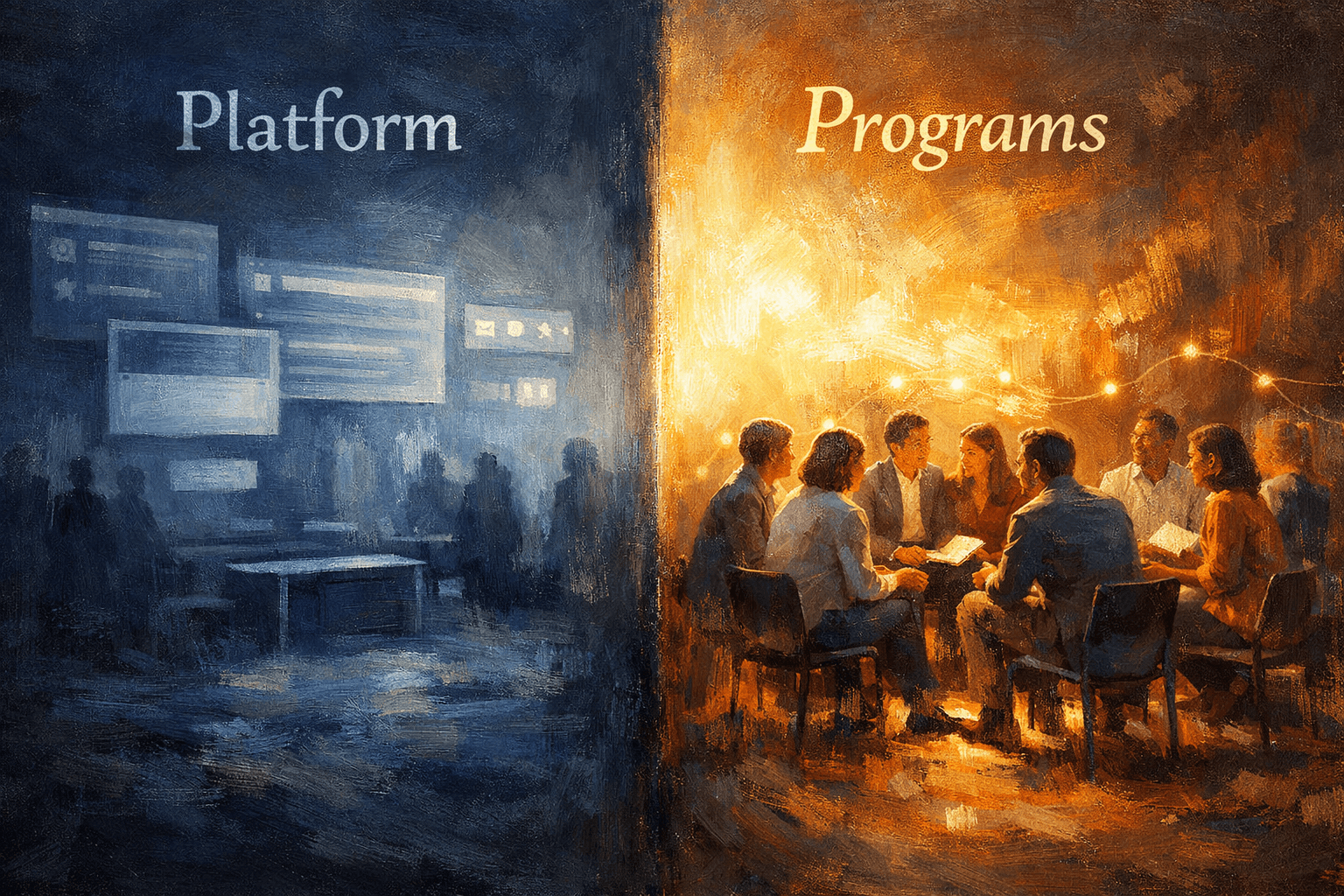
You Don't Need Another Platform
The case for precision programming over passive platforms
8-minute read
I've heard it dozens of times from association leaders: "We just launched a beautiful new community platform with discussion boards, member directories, and networking features. Now we're waiting for members to start engaging."
They're still waiting.
Your members don't want another platform to log into. They're not going to populate your pristine discussion boards or build vibrant communities in your member portal—no matter how many features you add.
This isn't because your members don't want connection. It's because you're asking them to do the work of creating value themselves, and they're already exhausted from managing seventeen other platforms that are algorithmically optimized to keep them scrolling.
The Platform Fallacy
The platform fallacy sounds logical on the surface: If we build it, they will come. Launch a feature-rich platform, promote it to members, and watch organic engagement flourish as members discover each other, share insights, and build community.
Except it doesn't work that way.
I learned this lesson the hard way at Mentor Collective, the mentoring platform I founded that now serves millions of college students at institutions including Harvard, Stanford, and Arizona State. When we started, we weren't building software at all—we were running mentorship programs manually, matching students with mentors one by one, coordinating meetings, and following up to ensure connections were meaningful.
Over time, we built tools to scale the administrative burden of running those programs. That became Mentor Collective.
Meanwhile, our competitors took what I'd call a "platform-first" strategy. They built gorgeous interfaces—essentially closed-garden versions of LinkedIn—with every feature imaginable: profiles, messaging, networking recommendations, resource libraries. They asked university administrators to blast these platforms out to students and alumni, assuming that if enough people signed up, a vibrant community would emerge organically.
I'll admit: we were initially terrified. Their platforms were beautiful. Ours was utilitarian.
But after years of conversations with higher education leaders, a pattern emerged. Nobody was signing up for those competitor platforms. And even when institutions managed to get initial registrations through aggressive marketing campaigns, members weren't coming back. Engagement flatlined within weeks.
Those beautiful platforms became silent graveyards. And worse than communicating no value, they communicated that nobody cared enough to participate—a devastating message for institutions trying to build community.
Why Platforms Fail: The Friction Problem
The failure of these platforms isn't surprising when you understand consumer behavior research on digital friction.
Research on digital onboarding consistently shows that even small amounts of friction drastically reduce engagement rates—with abandonment rates exceeding 50% when account opening takes more than 3-5 minutes. Each additional step—creating an account, remembering a password, navigating unfamiliar interfaces—creates an opportunity for users to abandon the experience entirely.
This friction compounds when your platform competes with consumer-grade alternatives members already use daily. LinkedIn has 1 billion users. Reddit has over 100 million daily active users. These platforms have invested hundreds of billions of dollars into algorithmic optimization designed to keep users engaged and returning habitually.
Your association doesn't have that budget. You're not going to out-LinkedIn LinkedIn or out-Reddit Reddit.
The data on platform abandonment is sobering: research shows that 75% of users abandon a product within the first week if they struggle during onboarding. For associations launching community platforms, this means that even if you convince members to create accounts, most won't return if the initial experience doesn't deliver immediate, obvious value.
And frankly, you shouldn't try.
A Tale of Two Approaches: Apple vs. Android
The platform-versus-program distinction reminds me of a famous contrast in consumer technology: Apple versus Android.
When Android launched, the value proposition was openness and customizability. Users could modify nearly every aspect of their experience, install any app from any source, and tailor their devices to their exact preferences. In theory, this flexibility should have been unbeatable.
Apple took the opposite approach: a curated, controlled ecosystem. Fewer choices. Less customization. But every interaction was intentionally designed to deliver a specific, high-quality experience with minimal friction.
The result? Despite Android's technical openness, Apple consistently dominates in user engagement, app revenue, and customer loyalty. Research shows that 92% of iPhone users stick with Apple when upgrading—dramatically higher than competitors—not because the platform is more powerful, but because the experience is deliberately crafted and effortless.
The lesson for associations: giving members a platform and asking them to create their own value is like handing them an Android phone with no apps installed and saying "customize it however you want." Most won't bother. They'll stick with what already works.
What Members Actually Want: Programs, Not Platforms
Platforms are reactive. They wait for members to show up and create value.
Programs are proactive. They deliver value directly to members.
Approach | Platform (Reactive) | Program (Proactive) |
|---|---|---|
Discussion & Knowledge Sharing | Launch a discussion board and hope members start posting questions and sharing insights | Organize eight professionals into a facilitated cohort that meets monthly to discuss specific challenges, with structured agendas and accountability |
Networking & Connection | Create member directories and networking features so people can "discover" each other | Launch a mentorship program that intentionally matches early-career members with experienced professionals, provides conversation guides, and maintains engagement |
Content & Learning | Build a resource library where members can upload and share content | Develop a cohort-based leadership academy with structured curriculum, peer learning, and tangible outcomes members can apply immediately |
Committee Work | Set up collaboration spaces and hope committee members use them | Create structured committee programs with clear objectives, automated scheduling, facilitated meetings, and deliverable tracking |
Professional Development | Offer on-demand webinars and hope members register | Run certification prep cohorts where members study together, hold each other accountable, and achieve dramatically higher completion rates |
The difference is fundamental. Programs create value for members. Platforms ask members to create value themselves.
Consider these real-world contrasts:
Platform thinking: "We have 50 discussion topics in our community. Members can browse and join conversations that interest them."
Program thinking: "We're matching 200 members into 25 peer advisory groups based on their role, experience level, and stated challenges. Each group meets quarterly with a trained facilitator."
Platform thinking: "Our member directory has advanced search filters so people can find colleagues with similar expertise."
Program thinking: "We're running a 6-month mentorship program where we've matched 150 mentee-mentor pairs, provided conversation prompts for each meeting, and we check in monthly to ensure relationships are progressing."
Platform thinking: "We've created spaces for regional chapters to coordinate activities."
Program thinking: "We're launching regional cohorts in 12 cities, each with 8-12 members who meet monthly to discuss local market challenges, with a volunteer chair and structured meeting agendas."
The pattern is clear: programs don't wait for engagement to emerge organically. They create the structure, provide the facilitation, and ensure value is delivered whether or not members would have created it themselves.
The Staffing Reality Associations Face
Even the best community platform needs humans to:
Seed discussions and respond to posts regularly
Recruit and train volunteer moderators
Create engaging content that sparks conversation
Monitor engagement metrics and intervene when activity drops
Develop creative campaigns to drive members back to the platform
Personally reach out to dormant members
For many associations, this means dedicating one or more full-time employees exclusively to community management. And even then, you're fighting an uphill battle against algorithmically-optimized alternatives that don't require membership fees.
By contrast, well-designed programs automate much of this operational burden while delivering dramatically higher engagement. At Mentor Collective, we built technology that handled matching, scheduling, reminder emails, and progress tracking—freeing staff to focus on program strategy and outcomes rather than administrative logistics.
That's the same philosophy behind RallyBoard. The platform handles the operational complexity of forming cohorts, managing schedules, and maintaining engagement, so association staff can focus on strategic program design rather than chasing members to log into another platform.
The Path Forward: Precision Programming
The associations that will thrive aren't those with the most sophisticated platforms. They're the ones that deploy precision programming—targeted, high-touch experiences that deliver immediate, personalized value.
What does precision programming look like?
Mentorship programs that proactively match members and provide structure for meaningful relationships
Cohort-based learning that brings small groups together around shared challenges with facilitated discussions
Leadership development academies with clear curricula and tangible skill development
Peer advisory groups where executives tackle real business problems together
Certification prep courses that combine expert instruction with peer accountability
These programs don't wait for members to create value. They deliver it directly.
Beyond engagement, precision programming creates new revenue opportunities. Well-designed cohort programs, leadership academies, and certification courses can command premium pricing as non-dues revenue streams. Members will pay for experiences that deliver tangible outcomes—the credential they need, the peer network that transforms their work, the structured development they can't find elsewhere. When associations shift from hoping members engage with free platforms to designing programs that deliver measurable value, they create offerings members are willing to invest in beyond their base membership fees.
And critically, modern technology makes it possible to deliver these high-touch experiences at scale without proportionally scaling staff. AI can handle intelligent matching. Automation can manage scheduling and reminders. Digital tools can facilitate discussions and track outcomes.
The technology serves the program. It doesn't replace it.
What This Means for Your Association
If you've already invested in a community platform, this isn't an argument to abandon it entirely. Email digests from your community likely provide value. Your discussion boards might serve a small segment of highly engaged members. Your member directory helps people find each other.
But don't confuse these tools with an engagement strategy.
Platforms are infrastructure. Programs are experiences.
The question isn't "Should we have a platform?" It's "What experiences are we creating for our members that deliver transformative value?"
If your engagement strategy relies primarily on building better platforms and hoping members will populate them, you're fighting a battle you cannot win. The budget required to compete with consumer-grade alternatives is measured in billions, not thousands.
But if you shift your focus to precision programming—proactively designed experiences that deliver immediate value—you're competing on terrain where associations have every advantage: trusted curation within professional communities, shared identity, and genuine understanding of what members need to grow.
Stop waiting for members to create value on your platform.
Start creating value for them through intentional programs.
That's the future of association engagement.