Member Engagement
Retention Rates: What Associations Can Learn From Spotify, Netflix, and Other SaaS Companies
Association leaders track renewal rates religiously but rarely ask the harder question: how many members engaged substantively in the last 30 days? By comparing association retention benchmarks to B2B SaaS and consumer subscription platforms, we explore why renewal rates are a lagging indicator—and why monthly engagement is the leading one.

Jackson Boyar
Co-Founder & CEO
·
12 min read
Most association leaders I talk to know their renewal rate. They track it quarterly. They celebrate when it ticks up a point. They panic when it dips.
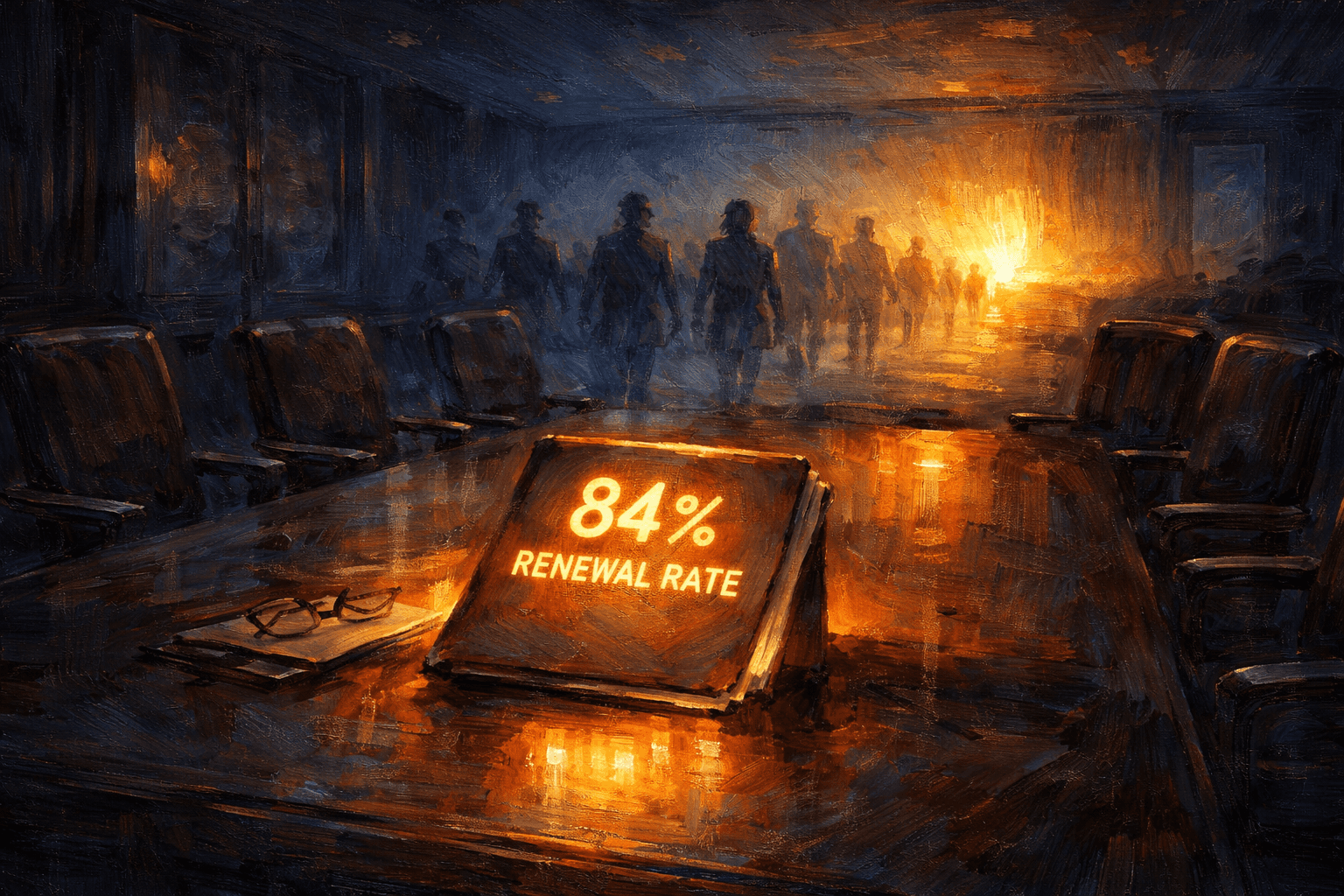
What most don't realize is that by the time a member decides not to renew, you've already lost them—months ago. The renewal rate is just the autopsy report. The actual cause of death was disengagement, and it happened long before the invoice went unpaid.
According to MGI's 2025 Membership Marketing Benchmarking Report, the median overall renewal rate for associations sits at 84%, with first-year member renewals lagging at just 75%. Those numbers have held remarkably steady for years. And that steadiness is part of the problem—it creates a false sense of stability while the underlying engagement crisis deepens.
Half of associations report no growth or decline in membership. Only 11% describe their own value proposition as "very compelling." And yet many of these same organizations are treating an 84% renewal rate as acceptable.
It's not. Not when compared to the organizations that have actually figured out retention.
The Comparison Associations Should Be Making
Association leaders tend to benchmark renewal rates against other associations. That's like comparing your restaurant's Yelp rating to the one next door when the real competition is DoorDash. The organizations your members compare you to aren't other associations—they're the subscription services, software platforms, and digital communities they interact with every day.
Organizational Membership: The B2B SaaS Comparison
Many associations serve organizational members—companies, institutions, or agencies that pay annual dues much like a B2B software subscription. The comparison is instructive.
According to 2025 SaaS benchmarking data from Benchmarkit and Maxio, the median gross revenue retention (GRR) for B2B SaaS companies is 90%, with top-quartile performers exceeding 95%. GRR measures the percentage of recurring revenue retained from existing customers, excluding any expansion or upsell revenue—making it the closest apples-to-apples comparison to an association's renewal rate. Best-in-class companies achieve net revenue retention above 120%, meaning they actually grow revenue from existing customers year over year through expansion, upsells, and deeper adoption.
The SaaS Capital 2025 Bootstrapped SaaS Benchmarks Report reports that even bootstrapped B2B SaaS companies with $3M–$20M in annual recurring revenue maintain a median GRR of 92% and a median net revenue retention of 104%.
Now compare that to association organizational renewal rates, which typically land between 80–90%. The gap isn't dramatic on the surface. But here's the critical difference: SaaS companies earning 90%+ GRR aren't achieving that through annual renewal reminders and conference discounts. They're earning it through daily or weekly product engagement, proactive customer success teams, and continuous value delivery that makes cancellation feel like a loss.
SaaS companies track engagement obsessively—login frequency, feature adoption, time-to-value, customer health scores. When usage dips, customer success teams intervene before the renewal date arrives. Research from Userlens shows that companies leveraging product usage data report retention rates 15% higher than those that don't.
Associations, by contrast, often have no idea whether an organizational member is engaged until the renewal invoice bounces. The engagement model between touchpoints is essentially: annual meeting, quarterly newsletter, renewal notice. That's not a retention strategy. That's a hope strategy.
Individual Membership: The Consumer Subscription Comparison
For individual professional memberships, the comparison shifts to consumer subscription services—and the gap becomes even more revealing.
Spotify maintains a monthly premium churn rate around 1.5–2% in the US market, according to 2024 data from research firm Antenna. That translates to an annual retention rate north of 80%. Recent reporting suggests Spotify Premium users have an overall retention rate of approximately 84%—almost identical to the median association renewal rate.
But here's what makes that comparison damning rather than comforting: Spotify achieves 84% retention while competing against Apple Music, YouTube Music, Amazon Music, and free ad-supported alternatives—all offering essentially the same catalog of 100 million songs. The switching cost is almost zero. A member can move to a competitor in under two minutes.
Netflix achieves even more impressive retention, with monthly churn hitting a record low of 2.17% in Q3 2024—roughly 75% annual retention—despite operating in a market where the average video streaming service experiences 5–10% monthly churn.
How do they do it? The answer isn't a mystery. These platforms deliver value to their subscribers every single day. Spotify learns your music taste, curates playlists, and becomes more valuable the longer you use it. Netflix's recommendation algorithm personalizes the experience so thoroughly that over 80% of content watched is discovered through recommendations. Duolingo, which saw paid subscribers grow 43% year-over-year in Q4 2024, has over 10 million users maintaining streaks of a year or longer—daily engagement baked into the product's DNA.
Now ask yourself: How many of your individual members interact with your association more than twice a year?
For most associations, the honest answer is almost none. Members attend the annual meeting (maybe), open a few newsletters, and receive a renewal notice. The engagement frequency isn't monthly or weekly—it barely qualifies as annual.
And yet associations are achieving retention rates comparable to Spotify's. How?
The Annual Meeting Subsidy: Why Renewal Rates Are Artificially Propped Up
The answer is conference discounts. For many associations, the primary driver of renewal isn't ongoing engagement—it's access to member pricing at the annual meeting. Renew your $300 membership, save $400 on conference registration. The math works. The retention strategy doesn't.
This creates a fragile dependency. Renewal rates are effectively subsidized by a single event that happens once per year. When that event becomes less accessible—or less compelling—the entire retention model buckles.
And that's exactly what's happening.
The Conference Attendance Problem
Multiple forces are converging to weaken the annual meeting as a renewal anchor.
Geopolitical and travel headwinds are reducing international attendance. The Global Business Travel Association reported in April 2025 that nearly a third of business travel buyers anticipated declines in travel volume, with 11% of non-American buyers already adjusting their US travel policies due to tariffs and immigration restrictions. A May 2025 report from the National Travel and Tourism Office found that business travel from Western Europe to the US declined nearly 18%, with Canadian business travel dropping 20% compared to the prior year.
The U.S. Travel Association projected a decline from 72.4 million international visitors in 2024 to 67.9 million in 2025—the first decline since 2020. For associations with significant international membership, this directly impacts conference-driven renewals.
Scientific and professional associations are already feeling the effects. Physics Today reported that professional societies are experiencing sinking conference attendance, with one society officer noting that it results in "reduced revenue, increased instability, declining participation and engagement, and heightened uncertainty regarding the future of conferences."
Not every member can justify travel every year. Even without geopolitical headwinds, the basic math has always been challenging. Conference attendance requires registration fees, airfare, hotel, meals, and days away from work and family. For a mid-career professional or someone at a smaller organization, attending every year simply isn't feasible. When the conference discount is the primary reason to renew, the years a member can't attend become the years they lapse.
Event attendance as a retention driver is showing strain. An ASAE article on rebuilding the membership model noted that while 62% of associations reported stable or rising event attendance in 2023, that dropped to 53% by 2024. The piece concluded that "events remain essential, yet they are no longer enough" and that "members now expect a continuous experience" extending beyond conferences.
The bottom line: when your renewal rate depends on a single annual event, every force that reduces conference attendance—travel restrictions, budget cuts, personal schedules, competing priorities—directly erodes your retention model.
The Real Risk: It's Not Just Dues
This should be an urgent priority for every association leader: most organizations are framing the engagement problem purely as a membership dues issue. They see a 16% lapse rate and calculate the lost dues revenue.
But disengagement doesn't just cost you $300 in membership dues. It costs you across every revenue line.
Sponsorship revenue depends on engaged eyeballs. When members aren't logging in, opening emails, attending events, or participating in programs, the audience your sponsors are paying to reach shrinks. Naylor Association Solutions' 2024 Association Benchmarking Report found that non-dues revenue has been the top financial challenge for associations three years running. And 73% of association professionals list increasing non-dues revenue as a top organizational priority. That priority gets harder to achieve when the audience isn't showing up.
Certification and credentialing revenue depends on members who see your association as central to their professional identity. A disengaged member isn't pursuing your credentials—they're pursuing alternatives or skipping credentialing altogether.
Publication and content revenue depends on members who value your intellectual property enough to pay for it. When ChatGPT, LinkedIn, and YouTube offer free alternatives, only members who feel a deep connection to your community will pay for your content.
Conference revenue itself depends on the cycle continuing. Members who don't engage between events eventually stop attending events. The post-conference energy dissipates. The peer connections formed over coffee don't get sustained. By the time next year's registration opens, the motivation to return has faded.
Disengagement is a slow bleed across your entire business model. Tracking renewal rates alone is like monitoring a patient's temperature while ignoring their blood pressure, cholesterol, and heart rhythm. The temperature might look stable right up until the crisis hits.
What Engagement-First Retention Actually Looks Like
If renewal rates are a lagging indicator, what's the leading indicator? Engagement frequency.
The organizations with the highest retention rates—whether B2B SaaS companies with 95%+ GRR or consumer platforms like Spotify and Netflix—share one trait: they create reasons for users to come back regularly. Not annually. Not quarterly. Monthly at minimum. Weekly or daily at best.
For associations, the goal should be clear: until members are engaging in a substantive way at least once per month, your association will struggle to be seen as a valuable investment. Not opening a newsletter—that's passive consumption. Substantive engagement means participating in something that creates professional value and human connection.
Here's what monthly engagement can look like in practice:
1. Deploy AI Chatbots for Instant Member Support
Modern AI chatbots can position your association as a daily utility rather than an annual event. When members can get instant answers to professional questions—drawing from your association's knowledge base, research library, and standards documents—they start turning to your association in their flow of work.
The value isn't just the answers. It's the data. Chatbot interactions reveal what members are searching for, what problems they're facing, and where your content strategy should focus. That intelligence feeds better programming, which feeds better engagement, which feeds better retention.
The limitation: chatbots are transactional. They solve problems but don't build relationships. They're a foundation, not a strategy. Think of them as hygiene—necessary infrastructure for a modern association, but not a differentiator by themselves.
2. Launch Structured Mentorship Programs
Mentorship creates some of the deepest engagement associations can offer. Research compiled by MentorcliQ shows that 76% of professionals believe mentors are important to their growth, yet only 37% currently have one—a gap associations are uniquely positioned to fill.
A well-designed mentorship program creates monthly touchpoints between mentors and mentees, builds professional relationships anchored to your association, and generates powerful word-of-mouth that drives recruitment. Members in active mentoring relationships have a compelling reason to renew that has nothing to do with conference discounts.
The challenge is scale. Traditional one-to-one mentorship is constrained by mentor supply—you can typically serve only 5–10% of your membership. But even at limited scale, mentorship programs create member evangelists whose enthusiasm for your association far exceeds what a newsletter can produce.
3. Create Cohort-Based Peer Learning Programs
Cohorts—small groups of 8–15 members who meet regularly around shared challenges or interests—address the scalability limitation of mentorship while preserving the relationship depth that drives retention.
Where a mentorship program needs 100 mentors to serve 100 mentees, a cohort program needs 10–15 facilitators to serve the same 100 members. Each member builds relationships with multiple peers, creating redundancy that individual mentoring relationships lack. When one member misses a meeting, the cohort continues. The structure is inherently more resilient.
Research published in the Journal of Organizational Behavior (2024) found that peer development groups create psychological safety, increase job satisfaction, and enhance professional development. These are exactly the outcomes that make members view their association as indispensable.
NACU (New American Colleges and Universities) provides a compelling example. After launching cohorts within their existing learning communities using RallyBoard, NACU achieved 650+ active member users across 24 cohorts, with members self-selecting as volunteer chairs without staff recruitment—a level of organic engagement that discussion boards alone had never produced.
The key advantage of cohort programs for retention: they create monthly engagement that members value enough to build their schedules around. When eight professionals are expecting you at next month's virtual meeting, you show up. And when those eight professionals are the reason your association membership matters to you, you renew.
4. Turn Your Online Community Into an Active Engagement Platform
Most associations already have community platforms. The problem is that fewer than 2% of members typically engage actively in discussion boards. Layering structured programs—cohorts, mentoring circles, study groups, committees—onto your existing community infrastructure transforms passive platforms into active engagement engines.
Higher Logic's 2025 research found that communities integrating volunteering and mentoring programs see 2.4× more logins and nearly 2× more contributors than those without these structured programs. The platform isn't the differentiator—it's what you do with it.
5. Extend Your Annual Meeting Into Year-Round Peer Engagement
Rather than treating your conference as the entire engagement strategy, use it as an anchor point for ongoing connection. Pre-conference cohorts build anticipation and relationships months before the event. Post-conference cohorts sustain the energy and hold members accountable for implementing what they learned. The conference becomes the highlight of a continuous engagement cycle rather than the entirety of your member experience.
This approach directly addresses the conference-dependency problem. Members who are engaged year-round through peer cohorts don't need the conference discount as their primary reason to renew. They're renewing for the ongoing professional value they experience every month.
The Engagement Frequency Benchmark
Let me propose a simple framework for association leaders:
If the average member engages with your association substantively fewer than 12 times per year, your renewal rate is vulnerable. Not email opens. Not passive page views. Substantive engagement: attending a cohort meeting, participating in a mentoring session, contributing to a committee discussion, completing a course module, or interacting with peers through your programs.
Spotify doesn't retain 84% of subscribers by sending monthly playlists to passive listeners. It retains them because the average user streams music for over 30 hours per month. Netflix retains subscribers because the average user watches content multiple times per week. Duolingo retains users because they've made daily engagement a habit through streaks and social features.
Associations don't need daily engagement to thrive. But they need monthly engagement to survive. The organizations that crack the code on getting members to engage at least once a month—in something that creates real professional value and human connection—will see their renewal rates climb naturally, without needing to rely on conference discounts or aggressive renewal campaigns.
The Stakes Are Higher Than Dues Revenue
A churned member in 2026 isn't just $300 in lost dues. It's a professional who has decided your association isn't worth their attention. And once you've lost their attention, you've lost their conference registration, their certification fees, their publication subscriptions, their sponsorship value, and their referrals. You've lost a node in your professional network—and the institutional knowledge and peer connections that node represented.
Worse, a generation of professionals who never develop the habit of engaging with your association won't suddenly start when they become senior leaders. The early-career member who lapses today is the executive director who doesn't know your organization exists in fifteen years. The sponsorship revenue your association needs in 2035 depends on the engagement habits you're building today.
The renewal rate will take care of itself when the engagement problem is solved. But the engagement problem won't solve itself by optimizing renewal emails and conference discounts.
Start This Quarter
You don't need to transform your entire engagement model overnight. But you do need to start moving from annual touchpoints to monthly ones.
This month: Audit your member engagement frequency. How many members had a substantive interaction with your association in the last 30 days? The answer will likely be sobering—and clarifying.
This quarter: Launch one program that creates monthly engagement for at least a segment of your membership. A mentoring pilot. A cohort program for your most active community. A committee revitalization initiative with modern infrastructure.
This year: Set a goal for what percentage of your membership engages substantively at least once per month. Track it as rigorously as you track renewal rates. Because engagement frequency is the leading indicator that renewal rates have always been lagging behind.
The associations that figure out monthly engagement will see their renewal rates climb above 90%. The ones that keep optimizing renewal notices will keep watching their 84% and wondering why it won't budge.
The technology to scale monthly engagement exists today. The member demand is proven. The only question is whether your association will lead this shift—or watch the next generation of professionals drift away one disengaged month at a time.