Podcast
Christie Tarantino-Dean on Board Culture, Betting on AI, and Leading IFT Through Change
How the CEO of the Institute of Food Technologists turned a strong board partnership into one of the most ambitious AI bets in the association industry.

RallyBoard Staff
·
6 min read
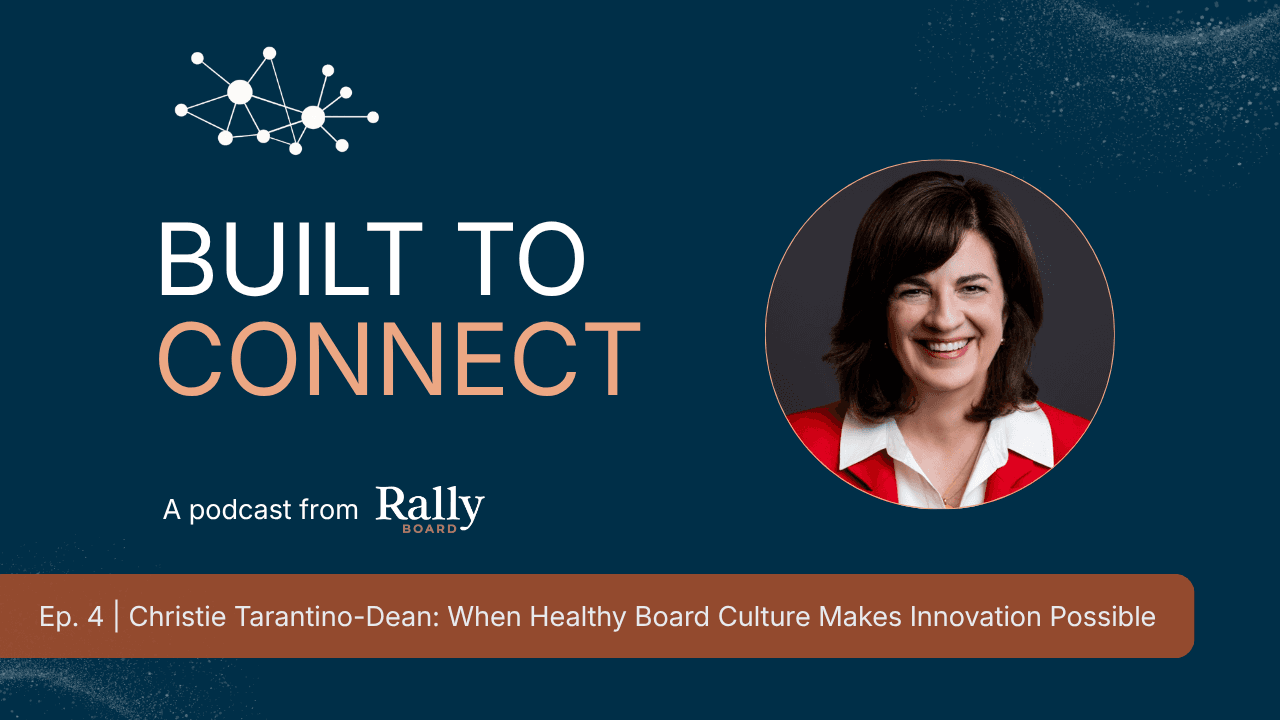
In this episode of Built to Connect, we sat down with Christie Tarantino-Dean, CEO of the Institute of Food Technologists (IFT), one of the most respected scientific associations in the world. Christie has spent more than 30 years in association leadership, including a tenure leading Association Forum in Chicago, which gave her a rare front-row seat to how the largest associations in the country actually operate. In 2024, she was named the recipient of Association Forum's Samuel B. Shapiro Award for Chief Staff Executive Achievement, the highest honor bestowed on an association professional.
We talked about board culture, member generations, the innovator's dilemma, and IFT's audacious launch of CoDeveloper — a proprietary AI-powered R&D platform that may be one of the boldest non-dues revenue bets in the industry. Here are the five takeaways every association leader should sit with.
1. Associations take on the personality of the profession they represent
Christie's most quoted line in the episode was also her most practical: associations inherit the culture of their members. Dentists are trained to be perfectionists. Food scientists work in teams. Lawyers debate. If you ignore that DNA, you'll struggle to lead.
"Associations take on the personality and the culture of the profession that they represent. And if we wanna move things forward, we have to understand that and then find ways that we can productively work together."
This isn't a soft observation. It changes how you recruit board members, how you write committee charters, how you communicate change, and how you decide which hills are worth dying on. Christie shared an example from her time at the Academy of General Dentistry: a board member told her, "If we're off by a millimeter, it might as well be a mile." Once she understood that perfectionism was baked into the profession, she could anticipate friction rather than be surprised by it.
Editorial note: This is why one-size-fits-all engagement playbooks fail. The strategies that work for a community of perfectionist clinicians look nothing like those that work for a community of entrepreneurial product developers. It's also why our team at RallyBoard configures matching, cohort structures, and facilitation rhythms to the personality of each association we work with. The platform is the same. The expression of it should never be.
2. The board onboarding process is the single biggest lever for governance
Most associations treat board orientation as a half-day calendar item. IFT treats it as a months-long process that begins before the new member is even official.
Christie walked through IFT's approach:
1:1 calls with incoming board members before orientation
Roughly four hours of pre-loaded videos, past board minutes, and organizational updates
A two-day onboarding session that includes outside trainers on good governance, case studies of past board decisions, and post-mortems on what could have been done better
Incoming members sit in on the June board meeting before they're official in September
"Our goal is ultimately for them to not feel like it will take them a year to understand how to contribute and that they're contributing from day one."
She also pointed out that the work starts even earlier: at the application stage. IFT's board application asks questions like "Give us an example of where you were not in favor of a decision, you were in the minority. How do you handle that?" Those questions signal the culture before someone is ever selected.
Editorial note: If your board cycles are short (one or two-year terms are common) and your onboarding is light, you're effectively asking new members to spend their first year learning while their term is already half over. The pattern shows up everywhere in associations: committees fail for the same reason — unclear mandates, no structured ramp, and volunteers expected to figure it out alone. The fix is the same in both places: invest in the front-end.
3. Bet on member-driven innovation, even when it doesn't scale at first
The most striking moment of the conversation came when Christie described the origin story of CoDeveloper, IFT's AI-powered R&D platform that launched at IFT FIRST in July 2025. It didn't start as an AI product. It started as a concierge service.
During the pandemic, IFT used Clayton Christensen's Jobs To Be Done framework (from his book Competing Against Luck) to interview members who hadn't renewed. They learned that the organization was so large and diverse that members struggled to get to what they needed quickly. So IFT hired a product developer on staff to manually answer technical questions for members. It wasn't scalable. But it taught them what members actually needed.
From that manual concierge service, a staff member — not Christie — brought forward the idea of using AI to do at scale what one person had been doing one call at a time. Today, CoDeveloper connects food scientists to IFT's 85+ years of peer-reviewed research through a generative AI co-scientist called Sous.
"My team, not me, brought forward this idea of what if we use AI to get people that information that they need quickly."
Two things stand out. First, IFT started with something that didn't scale (manual research support) precisely because that was the fastest way to learn. Second, the idea came from staff, not the CEO. Christie's job was to fund it, defend it to the board, and stay out of the way.
Editorial note: I've written before about why associations need to stop competing with Big Tech on content and start playing the games only they can win. CoDeveloper is the rare example of an association building something AI-native that Big Tech can't easily replicate, because the moat isn't the model. It's the 85 years of trusted, peer-reviewed scientific content underneath it. That's the playbook: figure out what your association uniquely owns, then use AI to deliver it 10x faster.
4. Resilience is the skill that compounds over time
When I asked Christie what no longer keeps her up at night, she didn't say strategy or AI or budgets. She said resilience.
"You will get through these hard times, and I think it is very important to build resilience. I do have a lot of history to look back on and say, 'No, I didn't get it right. This is what I learned from making some mistakes.' Had amazing mentors who were older than me, who'd been through a lot. I could not have done it without those people and my peers."
She became a CEO young and unexpectedly, after a board change at the Professional Convention Management Association. She moved the headquarters of an organization from Birmingham to Chicago as one of the few staff who made the transition. She's seen pandemics, recessions, generational shifts, and now an AI moment that's reshaping the entire knowledge economy. Each one taught her that you don't have to get it perfect. You have to keep going.
The corollary, which she also named: it's a lonely seat. One of her early mentors, a board member at PCMA, called her when she got her first CEO role and said, "It's a lonely seat, but let me know if you need anything. I'm here to help you." She's never forgotten it.
Editorial note: Christie's resilience point hits on something I think about constantly when building RallyBoard: peer networks aren't a nice-to-have for association leaders. They're survival infrastructure. The CEO peer group, the board mentor who picks up the phone, the colleague who's been through the same crisis three years before you — these relationships are how leaders actually get through hard moments. It's the same dynamic we see playing out for members inside our customer associations every day.
5. You can't make everyone happy. Lead for the 80%
The episode closed with Christie's hardest-won piece of advice: you cannot make every member happy, and trying to is a path to paralysis.
"As a former membership director, you want your members to all be happy. They're just not going to be. So how do we learn to live with the 20% who aren't happy with us to better serve the whole of the organization and be sustainable and relevant moving forward?"
She paired this with another insight that may be the most important strategic posture for association leaders right now: the willingness to not do things. IFT's board, she said, has been disciplined about asking "what aren't we going to do?" — a question that's almost impossible to answer well without a clear strategy. She framed it as a values-driven trade-off rather than a cost-cutting exercise. What are we choosing to invest in, what are we sunsetting, and what does that say about who we are?
Editorial note: This is the innovator's dilemma in association form. The legacy programs that built your organization are the same programs that consume the resources you'd need to build what's next. Christie's IFT made the call to invest reserves into CoDeveloper rather than spread them thinly across incremental program improvements. Most associations won't have that kind of board alignment on day one. But the question — what aren't we going to do? — is one every leadership team should be able to answer in a single sentence.
Final thought
Christie's leadership at IFT is a master class in what becomes possible when a CEO invests early in board culture, listens hard to staff, and gives a strong team room to bet on the future. CoDeveloper might end up being the most successful non-dues revenue innovation in the industry, or it might end up being a lesson in what it takes to try. Either way, it exists because Christie spent years building the trust and governance discipline that made the bet possible.
That's the through-line of every conversation I have on this podcast: associations don't transform through strategy decks. They transform through relationships — between CEOs and boards, between staff and volunteers, between members and peers — that have been carefully built over time.
🎧 Listen to the full episode of Built to Connect with Christie Tarantino-Dean on rallyboard.com/resources/podcast or wherever you get your podcasts.