Back
In House Operations
RallyBoard is a purpose-built platform for designing and scaling cohort-based peer learning programs at associations. Running programs in-house means piecing together general-purpose tools — Zoom, Doodle Polls, WhatsApp, Google Docs, and more — with staff coordination filling the gaps. This comparison is for association leaders who are weighing whether to build infrastructure themselves or deploy a dedicated solution.

vs.
Overview
For most associations, the "alternative" to RallyBoard isn't another platform — it's the status quo: staff-coordinated programs stitched together from tools that weren't designed for the job. This is the most common approach to running cohort-based programs today, and it works — up to a point. A lean team can manage a handful of groups using a combination of Zoom, shared calendars, email threads, Slack channels, and Google Docs. But that model hits a ceiling quickly, and the ceiling tends to arrive right when member demand is highest.
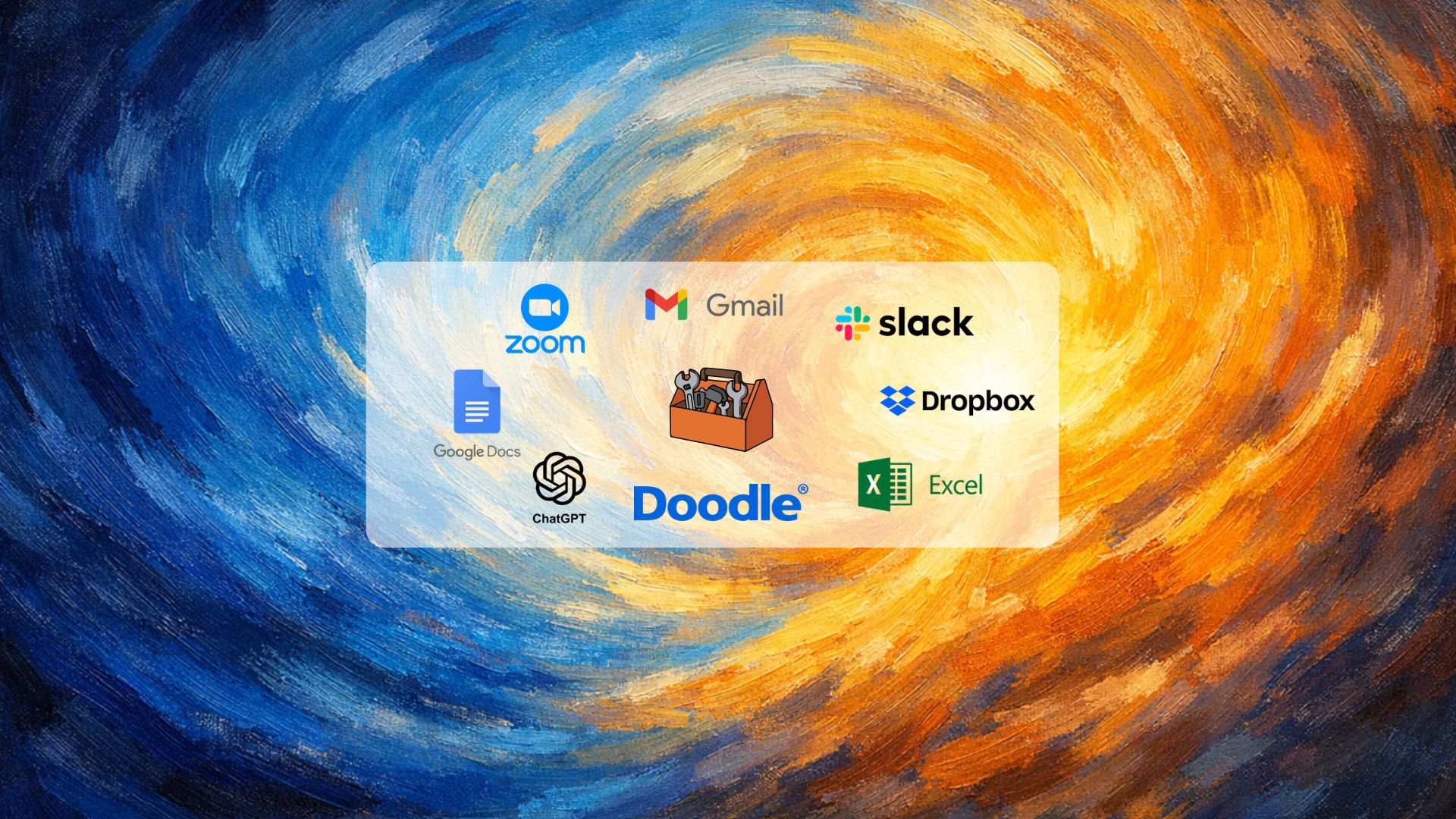
The DIY stack typically looks something like this: Zoom or Microsoft Teams for video meetings, Google Calendar or Outlook for scheduling, Slack or Teams channels for ongoing communication, Google Docs or SharePoint for shared notes and agendas, Trello or Asana for task tracking, Dropbox or SharePoint for file storage, and email for everything else. Each of these tools is capable in its own domain. The problem is integration — or rather, the lack of it. Nothing connects member profiles to group formation, scheduling to attendance tracking, or meeting summaries to program analytics. Staff become the connective tissue, manually bridging every gap.
RallyBoard is a cohort-based peer learning platform for associations built to replace that connective tissue with automation. It handles matching, scheduling, facilitation support, engagement nudging, and analytics in a single system — designed specifically for the workflows associations run: committees, group mentoring, shared interest groups, certification prep cohorts, and more.
🔧 The DIY Stack: What You're Actually Managing
Running programs in-house isn't just a technology decision — it's a staffing decision. Every tool in the DIY stack requires someone to own it, update it, and coordinate across it. Common ownership burdens include:
Matching: Manually reviewing member profiles, intake forms, and availability to form groups — a process that can take weeks for even a modest program
Scheduling: Running Doodle polls across 10, 20, or 50 groups — then waiting on responses, chasing stragglers, picking a time that works for most, sending calendar invites, and repeating the entire cycle when a meeting needs to be rescheduled. At scale, this alone can consume dozens of staff hours per program cycle
Communication: Creating and maintaining Slack channels, distribution lists, or Teams spaces for each cohort — and keeping them active
Documentation: Collecting and distributing meeting notes, agendas, and action items across Google Docs or SharePoint folders
Engagement tracking: Manually monitoring attendance, following up on dormant groups, and nudging disengaged members
Reporting: Pulling data from disparate sources to build any kind of program-level view
RallyBoard automates all of these steps. The platform uses configurable AI matching to form groups from member profile data, auto-schedules Zoom meetings based on cohort availability, generates AI meeting summaries, nudges members who go quiet, and surfaces program analytics in a unified dashboard. Associations like NACU have used this to scale from a handful of active communities to 24 cohorts serving 650+ members — without adding staff.
📈 The Scaling Problem
The DIY model scales linearly — or doesn't scale at all. Each new cohort adds roughly the same staff overhead as the last. If managing 5 groups takes 10 hours per week, managing 25 groups approaches a full-time role. This is why so many associations cap their programs at whatever number their team can manually sustain, even when member demand would support more.
PMI's group mentoring pilot illustrates the contrast. PMI has 700,000 members across 190+ countries. Running even a fraction of those members through a manually coordinated mentoring program would be operationally impossible without dedicated staff at massive scale. With RallyBoard, PMI launched what became the largest mentoring program in their history — 62 group meetings and 16,500+ minutes on Zoom in the first 1.5 months — with a lean team and automated infrastructure.
The DIY model's ceiling isn't a failure of ambition. It's a predictable consequence of using general-purpose tools for a specialized workflow. RallyBoard was co-developed with associations specifically to remove that ceiling.
🔗 Integration vs. Replacement
One point worth clarifying: RallyBoard doesn't eliminate Zoom, email, or calendaring. It sits on top of them. Meeting links are Zoom-powered. Reminders go out via email and text. Members don't need to download a new app or learn a new platform to participate — they receive a calendar invite, join their Zoom meeting, and get a follow-up summary in their inbox. This is a meaningful distinction for associations concerned about member adoption friction.
What RallyBoard replaces is the staff coordination layer — the manual work of stitching those tools together for every cohort, every cycle, every program. Associations like HFMA use RallyBoard alongside their existing AMS and community platform, not instead of them.
📬 The Deliverability Problem
One friction point that rarely shows up in DIY planning discussions — but surfaces quickly in practice — is calendar and email deliverability. When associations send meeting invites and reminders through generic tools like Google Calendar, Outlook, or a bulk email platform, those communications compete with everything else in a member's inbox. Invites land in spam. Reminder emails get filtered. Members miss meetings not because they're disengaged, but because the logistics never reached them reliably.
This is an area of active development for RallyBoard. The platform is investing specifically in ensuring that scheduling communications — invites, reminders, and follow-ups — actually reach members and convert to attendance. That means deliverability infrastructure, send-time optimization, and multi-channel nudging (email and text) so that the coordination work the platform does on the back end translates into members showing up on the front end. For associations where attendance rates on virtual programming have been disappointing, this is often a contributing factor that a DIY stack has no systematic answer for.
🤖 "Can't We Just Build This with AI?"
It's a fair question in 2026 and beyond, and association leaders are increasingly hearing it from boards and technology committees: why pay for a platform when AI tools can generate software in hours? The short answer is that they can — and the result is usually something that works in a demo and breaks in production.
RallyBoard's engineering team is based in Silicon Valley and builds using AI-assisted development tools. If vibecoding a production-grade cohort platform were achievable overnight, they would have done it. Instead, the platform represents over a year of deliberate backend architecture, association-specific workflow design, and infrastructure built to handle the real-world complexity of running programs at scale: matching algorithms that account for timezone, seniority, career stage, and organizational type simultaneously; scheduling infrastructure that resolves group availability across dozens of concurrent cohorts; deliverability systems that ensure communications actually reach members; and an analytics layer that surfaces meaningful signal from hundreds of simultaneous conversations.
AI-assisted development is genuinely useful for accelerating code generation. What it doesn't produce automatically is the underlying architecture — the decisions about how data flows, how systems degrade gracefully under load, how privacy controls interact with AI summarization, and how a platform behaves when it's managing 24 cohorts versus 240. Those decisions accumulate over time through iteration with real customers, and getting them wrong produces what engineers call a spaghetti codebase: something that appears to work until it doesn't, and is nearly impossible to maintain or extend when it fails.
The DIY-with-AI path is genuinely worth evaluating for associations that have in-house engineering talent and a narrow, well-defined use case. For associations without a dedicated engineering team, or those running programs at the scale where reliability and consistency matter, the infrastructure risk of a custom-built solution is a real consideration — not just the initial build cost, but the ongoing maintenance, iteration, and support burden that follows.
💰 Pricing
DIY programs have no direct software cost beyond the tools an association likely already licenses (Zoom, Google Workspace, Microsoft 365). But the true cost is staff time: the hours spent on matching, scheduling, coordination, and follow-up that don't show up on a software invoice. RallyBoard pricing is not published publicly; associations should contact the team directly for a quote based on program scope and member volume.
Feature Comparison
Capability | DIY (Multi-Tool Stack) | RallyBoard |
|---|---|---|
Member matching / group formation | Manual — staff review profiles and assign groups | AI-powered — configurable algorithms match by goals, career stage, geography, and more |
Meeting scheduling | Manual — Doodle polls, calendar invites, back-and-forth coordination | Automated — groups scheduled based on cohort availability; Zoom links generated automatically |
Video meeting infrastructure | Zoom or Teams (separately licensed and managed) | Built on Zoom — meetings hosted within the platform |
Agenda & facilitation support | Staff-created or ad hoc — Google Docs, email | AI-generated agenda suggestions, topic voting, structured facilitation tools |
Meeting notes / summaries | Manual note-taking or separate AI tools | AI-generated meeting summaries delivered automatically to participants |
Attendance tracking | Manual — reviewing Zoom reports or asking chairs | Automated attendance tracking per cohort and program |
Engagement nudging | Manual — staff follow up with dormant groups | Automated smart nudges for participants and volunteer chairs |
Volunteer chair management | Email-based recruitment, manual onboarding | Role assignment built into the platform; chairs self-select and receive tooling |
Program-level analytics | Assembled manually from disparate sources | Unified Engagement Digest with cohort-level sentiment, attendance trends, and keyword tracking |
Member privacy controls | Depends on tools used | AI notetakers can be disabled at the cohort level; data is anonymized |
Member experience | Variable — depends on how consistently tools are used | Consistent — calendar invite + Zoom + email/text, no new app required |
Number of cohorts supportable | Limited by staff capacity | Hundreds of active cohorts with a few hours/week of staff time |
AMS / LMS integration | Requires custom work | Designed to complement existing systems, not replace them |
Time to launch new cohort | Days to weeks (manual intake, matching, scheduling) | Hours — from intake form to scheduled meetings |
Email & calendar deliverability | Dependent on generic tools (Gmail, Outlook, bulk email); invites frequently filtered or missed | Active area of investment — multi-channel delivery (email + text), optimized to maximize member attendance |
Common Use Cases
Use Case | DIY Approach | RallyBoard |
|---|---|---|
Managed via email lists, shared docs, calendar invites; chairs coordinated manually | Automated scheduling, AI agendas, attendance tracking, and chair tooling built in | |
Slack channels or email lists; engagement fades without active staff management | Structured cohorts with nudging to maintain momentum; groups self-organize | |
Pre/Post-Annual Meeting | Follow-up largely left to attendees; hard to sustain connections made at events | Cohorts matched from annual meeting attendees; relationships continue year-round |
Study groups coordinated ad hoc; inconsistent experience | Structured cohorts with shared agendas, resource sharing, and accountability built in | |
Volunteer Engagement | Volunteer identification and recruitment is staff-intensive; retention is ad hoc | Volunteers self-select as chairs; platform provides tooling to support and retain them |
Most associations can support only a few cohorts manually; demand far exceeds supply | AI matching pairs mentors and mentees at scale; PMI ran their largest mentoring program in history using RallyBoard | |
Executive Mastermind Groups | High-touch coordination required for senior members; difficult to scale | Curated matching by seniority, function, and geography; structured cadence with minimal staff overhead |
When To Choose RallyBoard
🧩 Your team is spending significant staff hours on logistics — scheduling, coordination, and follow-up are consuming time that should go toward program quality and member relationships
📊 You want to run more programs than your current capacity allows — demand exists but the manual coordination model creates a hard ceiling on how many cohorts you can support
🔁 Programs go dormant without constant staff intervention — member engagement fades when there's no automated nudging or structured cadence to keep groups active
🎯 You need consistent, measurable outcomes — the DIY stack makes it difficult to track attendance, sentiment, or program impact across cohorts without significant manual effort
🚀 You're launching a new program type and want a replicable framework — RallyBoard provides the infrastructure to pilot, learn, and scale without rebuilding the coordination model each time
🤖 Your board or leadership is asking "why can't we just build this with AI?" — the engineering complexity of a production-grade cohort platform at association scale is real; RallyBoard's Silicon Valley team builds with AI tools and it still took over a year of backend development to get right
📬 Attendance on virtual programming is lower than it should be — if members are registering but not showing up, deliverability and nudging infrastructure may be part of the problem; RallyBoard is actively investing in this layer
🤝 Volunteer adoption and chair recruitment are ongoing challenges — the platform gives chairs the tools to self-organize, reducing the burden on staff to recruit and support them
Bottom Line
Running cohort-based programs in-house is viable — associations do it every day with Zoom, shared docs, email, and a lot of staff effort. The question isn't whether it works; it's whether it scales, and at what cost. For associations managing a small number of cohorts with stable staff bandwidth, the DIY model may be sufficient. For associations looking to reach more members, launch more program types, or reduce the operational burden on a lean team, a purpose-built platform like RallyBoard addresses a different set of constraints. The decision ultimately comes down to how central cohort-based peer learning is to your membership value proposition — and whether your current infrastructure can support the ambition.
Learn how RallyBoard compares to alternatives and complementary solutions.
View all