Back
Strategy

RallyBoard Staff
Why This Distinction Matters for Associations
Association executives often default to "community platform" when searching for technology to improve member engagement. That instinct makes sense — platforms like Higher Logic and Hivebrite have been the standard for over a decade. But "community" has become a catch-all term that obscures meaningful differences in how members actually engage.
According to Higher Logic's 2024 Association Community Benchmark Report, only 15% of community members are active within a 120-day period, even when the platform is well-designed and well-promoted. The challenge is not access — it's activation. Forums favor a vocal minority, while the majority of members remain passive consumers. Meanwhile, the MGI 2025 Membership Marketing Benchmarking Report found that half of associations report no growth or decline in membership, and only 11% describe their value proposition as "very compelling."
Peer learning platforms address a different problem entirely. Rather than opening a door and hoping members walk through it, they assign members to small groups, schedule recurring meetings, and structure the experience around shared goals. The engagement model is closer to a graduate seminar than a town hall.
Understanding which model fits your objectives — or recognizing that you need both — is one of the most consequential technology decisions an association can make right now.
What Is a Community Platform?
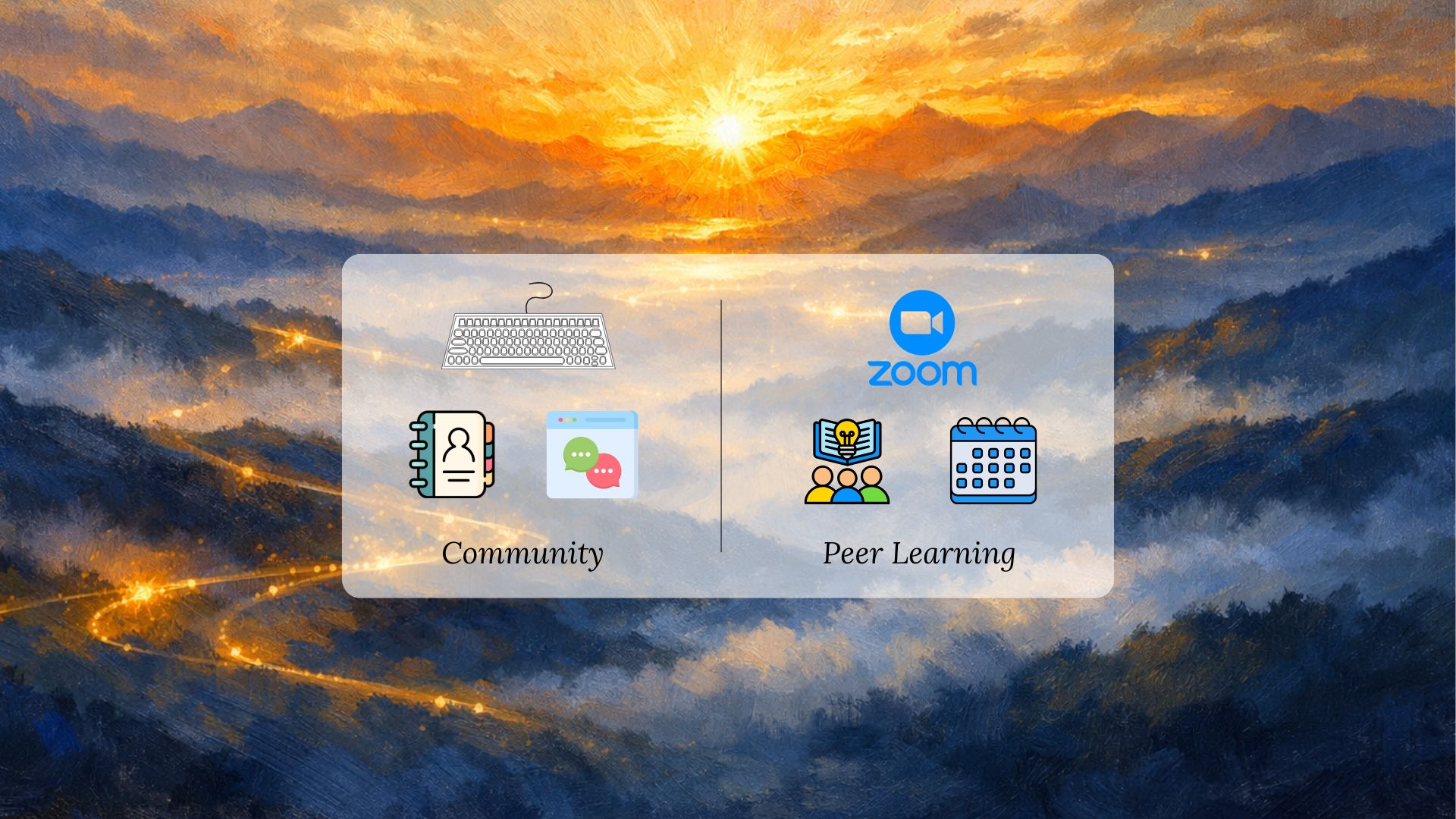
A community platform provides persistent, many-to-many digital spaces where members can post, discuss, share resources, and network on their own terms. Think discussion forums, interest-based groups, content libraries, member directories, and event listings — all in one place.
Core capabilities typically include:
Discussion forums and groups — Topic-based threads where members ask questions, share insights, and interact asynchronously. This is the backbone of most association community platforms.
Member directories and profiles — Searchable databases that let members find and connect with peers by role, geography, expertise, or interest area.
Content sharing and libraries — Spaces for uploading and organizing articles, presentations, templates, and other resources contributed by staff or members.
Event promotion and integration — Calendars, registration links, and post-event discussion threads tied to conferences, webinars, and chapter meetings.
Notifications and digests — Email-based alerts that surface new activity and attempt to draw members back into the platform.
Leading community platforms for associations:
Higher Logic — The most widely adopted community platform among associations, with deep AMS integrations and a heritage in listserv-to-forum migration. Strong among large, established associations.
Hivebrite — An all-in-one community management solution popular with associations and alumni networks. Offers job boards, events, fundraising tools, and a customizable member portal alongside community features.
Breezio — A content-centric community platform built for associations, with particular strength in social learning, collaborative content, and committee management tools.
Forj — Combines community (Forj Connect) and learning management (Forj Learn) in a single system, positioning itself as an integrated engagement and education platform for associations.
Circle — A modern, creator-focused community platform with courses, community spaces, and membership tools. Increasingly used by smaller associations and membership organizations, though not purpose-built for the association market.
Community platforms excel at creating a persistent home base for member interaction. They are the right choice when an association's primary goal is broad networking, asynchronous discussion, and content distribution across a large member base.
What Is a Peer Learning Platform?
A peer learning platform takes a fundamentally different approach. Rather than providing an open space and hoping members engage, it designs structured programs — cohorts, roundtables, study groups, mentoring circles — and uses AI to match members into small groups based on specific criteria like career stage, role, geography, or development goals.
Core capabilities typically include:
AI-powered matching — Algorithms that analyze member profiles, intake surveys, and stated goals to create small groups (typically 5–20 members) where participants share relevant context and can offer each other actionable perspective.
Automated scheduling — Group availability coordination that eliminates the back-and-forth of manual scheduling. Members indicate availability, and the platform finds optimal meeting times across time zones.
Collaboration and agenda tools — Topic voting, resource sharing, and structured agendas that give each meeting a clear purpose. Members arrive prepared rather than hoping for spontaneous discussion.
Meeting infrastructure — Integrated video hosting (typically Zoom), AI-generated meeting summaries, and attendance tracking that reduce administrative overhead for both staff and volunteer facilitators.
Behavioral nudging — Automated reminders and engagement prompts calibrated to maintain momentum across recurring meeting cycles. This addresses the dropout problem that plagues voluntary programs.
Live chat and direct messaging — Real-time, in-group messaging that replaces post-based discussion threads. The immediacy of contact — the ability to ask a question and get a response from a peer within minutes rather than days — is what drives ongoing engagement between scheduled meetings and keeps cohorts active throughout the program cycle.
Engagement analytics — Dashboards and digests that surface participation trends, discussion themes, and member sentiment — giving association staff visibility into program health without requiring them to attend every session.
The leading peer learning platform for associations is RallyBoard, which is purpose-built for the association market and currently works with organizations including the Project Management Institute (PMI), the Healthcare Financial Management Association (HFMA), NACU, INFORMS, and AIIM. No other platform combines AI matching, automated cohort logistics, and association-specific program design in a single product.
Other platforms operate in adjacent spaces but serve different audiences. Chronus and Art of Mentoring focus on 1:1 and group mentoring, primarily for corporate employers. Maven, Teachfloor, and Disco offer cohort-based learning for individual creators and course builders, but lack association-specific features like AMS integration, chapter-level deployment, and multi-program analytics.
How They Differ: A Side-by-Side Comparison
Dimension | Community Platform | Peer Learning Platform |
|---|---|---|
Engagement model | Open, self-directed; members choose when and how to participate | Structured, assigned; members are matched into groups with scheduled commitments |
Group structure | Large forums, interest groups, and discussion threads (dozens to thousands of members) | Small cohorts of 5–20 members, matched by AI on shared criteria |
Content flow | Member-generated posts, staff-curated libraries, asynchronous threads | Facilitated agendas, topic voting, and live discussion with AI-generated summaries |
Typical engagement rate | ~15% of members active within a 120-day period (Higher Logic 2024 benchmarks) | 50–60%+ attendance rates in structured cohort programs (based on RallyBoard customer data from PMI and HFMA) |
Scheduling | Self-service; members access content on their own time | Automated group scheduling across time zones, with recurring cadence |
Staff effort to maintain | Moderate — requires content moderation, community management, and activity seeding | Low after setup — AI handles matching, scheduling, and nudging; staff focus on program design |
Best for | Broad networking, Q&A, resource sharing, member directories, chapter coordination | Mentoring programs, leadership development, certification study groups, peer roundtables, annual meeting cohort extensions |
Member experience | Browse, post, react — similar to social media or a forum | Assigned peer group with a recurring meeting rhythm — similar to an executive roundtable |
Analytics | Post views, replies, active users, content downloads | Attendance rates, discussion topics, sentiment trends, cohort-level engagement metrics |
Examples | Higher Logic, Hivebrite, Breezio, Forj, Circle | RallyBoard |
When to Use Each — and When You Need Both
Choose a community platform if your primary goal is:
Creating a persistent digital home for your membership that's available 24/7
Hosting asynchronous Q&A and discussion across broad interest areas
Providing a member directory and networking tool
Distributing content and resources at scale
Migrating from a legacy listserv
Choose a peer learning platform if your primary goal is:
Running structured programs like mentoring cohorts, certification study groups, leadership roundtables, or peer advisory circles
Driving measurable engagement outcomes (attendance rates, NPS, retention correlation)
Activating the ~85% of members who do not participate in open community platforms (per Higher Logic's 2024 benchmarks)
Scaling high-touch programs without proportionally scaling staff
Generating member intelligence from structured conversations (e.g., what topics members care about, what challenges they face)
Use both when:
Most mid-to-large associations will benefit from running a community platform and a peer learning platform in parallel. The community platform provides the broad digital home base — the always-on space where members can browse, post, and connect informally. The peer learning platform provides the high-engagement programming layer — the structured experiences that drive deeper outcomes and give the "quiet majority" of members a reason to participate actively.
This is the approach taken by organizations like HFMA, which uses existing infrastructure for broad member communication while deploying RallyBoard to run targeted cohort programs across its volunteer leaders, emerging professionals, and executive council members. The two systems serve different purposes and different member behaviors.
Evidence From Association Deployments
Peer learning platforms are relatively new in the association market, which makes real-world data especially important for evaluating the model. The following outcomes are drawn from published case studies of associations using RallyBoard.
Project Management Institute (PMI)
PMI — the world's largest project management association with 700,000+ members — launched a group mentoring pilot with RallyBoard in late 2024 that became the largest-scale mentoring program in PMI's history. Key results from the initial 1.5-month pilot:
62 group meetings conducted across multiple time zones
16,500+ minutes of live member engagement on Zoom
7–9 members per group, with 2 co-chairs (mentors) and 6–7 mentee participants per cohort
57% average attendance rate — without manual follow-up from staff
AI-powered matching based on intake form data, with automated scheduling eliminating logistical overhead
PMI is now using pilot results as a blueprint to scale mentoring across its global chapters, starting with its Middle East and North Africa (MENA) region. The Learning division is also actively running new cohort-based programs focused on skill development and participatory peer learning.
Healthcare Financial Management Association (HFMA)
HFMA — serving 140,000 healthcare finance professionals — launched three distinct program designs on RallyBoard targeting different member segments: executive council members, chapter leaders, and emerging leaders. Results from September 2025 through January 2026:
16 unique cohorts running across 3 program designs
60+ Zoom meetings with 18,000+ minutes of engagement
278 agenda topics generated by participants through RallyBoard's topic voting feature
Executive council members matched by organizational type, geography, and strategic focus
Emerging leaders matched by career stage, functional focus, organizational setting, and development goals
RallyBoard's Engagement Digest feature surfaced anonymized trends from cohort conversations, giving HFMA's strategy team real-time visibility into member priorities
HFMA's leadership team had originally been inspired by Chief, the executive cohort network, and sought to replicate that structured peer learning model across its own membership at scale.
New American Colleges and Universities (NACU)
NACU — a consortium of 25+ colleges — used RallyBoard to revive dormant learning communities and launch new ones without adding staff. Results from a pilot launched in February 2025:
650+ member users across 24 active cohorts
2x increase in active community chairs — with members self-selecting as chairs without staff recruitment
Over 50% feature adoption across the platform
Expanded from an initial 8-community pilot to all learning communities within months
NACU's VP of Programs and Communications, Michelle Apuzzio, noted that the platform allowed staff to shift from managing logistics to focusing on strategic community development — a shift that had been impossible under the previous model of manual coordination.
Frequently Asked Questions
What is the difference between a community platform and a peer learning platform?
A community platform provides open, persistent spaces for asynchronous discussion, networking, and content sharing — similar to a forum or social network. A peer learning platform organizes members into small, structured groups (cohorts) matched by AI, with automated scheduling, facilitated agendas, and recurring meetings. Community platforms optimize for broad access; peer learning platforms optimize for deep engagement and measurable outcomes.
Do I need both a community platform and a peer learning platform?
It depends on your engagement strategy. If your only goal is hosting discussion forums and member directories, a community platform is sufficient. If you want to run structured programs — mentoring cohorts, certification study groups, leadership roundtables — a peer learning platform is the better fit. Most mid-to-large associations benefit from both: a community platform for broad interaction and a peer learning platform for high-engagement programming.
Can a community platform like Higher Logic do what RallyBoard does?
Higher Logic and similar platforms offer subgroups and some learning features, but they are architecturally designed for many-to-many, asynchronous interaction. They do not provide AI-powered member matching, automated cohort scheduling, structured meeting facilitation, or cohort-level engagement analytics. These are distinct capabilities that require a purpose-built peer learning platform.
How much does RallyBoard cost compared to community platforms?
Pricing varies by organization size and program scope. RallyBoard's pricing is typically structured around the number of active programs and participants, whereas community platforms often charge per-member or on a tiered license basis. Current pricing details are available at rallyboard.com/pricing. For associations already running a community platform, RallyBoard layers on top as a complementary system rather than a replacement.
Can RallyBoard integrate with our existing AMS or community platform?
RallyBoard is designed to work alongside existing association technology stacks, including single sign-on (SSO) support and data sync with common association management systems. The platform does not replace community infrastructure; it adds a structured peer learning layer on top of it.
What types of programs can I run on a peer learning platform?
Associations use peer learning platforms for group mentoring programs, certification study groups, leadership development cohorts, peer advisory roundtables, committee and task force collaboration, annual meeting pre- and post-conference cohorts, emerging leader networks, and volunteer support communities. Any program that benefits from small-group structure, recurring meetings, and intentional member matching is a fit.
How long does it take to launch a peer learning program on RallyBoard?
Based on published case studies, associations have launched initial pilot programs within weeks. PMI's group mentoring pilot went from design to active meetings in a matter of weeks. NACU launched its first 8 learning communities in February 2025 and expanded to all communities within months. The platform's AI handles the most time-intensive parts — matching members and scheduling meetings — which compresses timelines significantly compared to manual program design.
Is a peer learning platform only for large associations?
No. While PMI (700,000+ members) and HFMA (140,000+ members) represent large-scale deployments, NACU's consortium of 25+ institutions demonstrates that peer learning platforms are effective for smaller networks as well. The automation that makes these platforms valuable at scale — AI matching, scheduling, nudging — is equally valuable for lean teams that lack dedicated staff for program coordination.
Review more playbooks on scaling member engagement
View all