RallyBoard
RallyBoard Next Chapter | Spring 2026
A recap of RallyBoard's Spring 2026 Product Update — the milestone that moves cohort-based engagement from a design-partner beta into a self-service platform any association can use.

Jackson Boyar
Co-Founder and CEO
·
8 min read
Handing over the keys
We wrote the first line of RallyBoard code in January 2025 with a simple but ambitious mission: test as many models of peer learning as possible, as quickly as possible, with real associations and real members.
By spring 2025, we had launched with a handful of exceptional design partners — PMI, HFMA, and NACU among them. Over the following year, we worked side-by-side with those teams to launch, monitor, and study more than 100 cohorts in the wild.
For most of that time, RallyBoard staff held a lot of the controls. Partners told us which cohorts to launch; we handled matching, scheduling, and onboarding on the back end. That model got us off the ground, but it was never the destination.
Today is the destination. We're handing over the keys.
The beta phase by the numbers:
100+ cohorts launched, monitored, and studied in real time
100,000+ minutes of member-to-member Zoom engagement
50%+ average participation rate across recurring meetings
And as I like to remind our team: this is the worst RallyBoard will ever be. Every release from here on makes it better.
What's new in Spring 2026
We shipped three major updates today:
Launch Center — Self-service cohort launches, with two beta formats (Existing Roster and New Intake) and a third alpha format (Custom Selection)
Calendaring, rebuilt — Native calendar infrastructure with improved invite deliverability across Gmail, Outlook, and Yahoo
Signals (beta) — Anonymized, real-time feedback surfaced from cohort meetings
Below, a closer look at each.
1. Pick your launch format
Every cohort-based program starts with the same question: Where do participants come from?
Launch Center gives you three paths:
New Intake (beta) — Publish an intake form, collect applications, and let AI automatically match participants into cohorts. Ideal for new programs where you don't know who's in yet.
Existing Roster (beta) — Upload pre-formed groups as a CSV and skip intake and matching entirely. Ideal for standing committees, chapters, SIGs, or any program where the groups are already defined.
Custom Selection (alpha) — Match across submissions from any intake form you've ever run, including historical ones. Useful when you want to pull from multiple past applications into a single new set of cohorts.
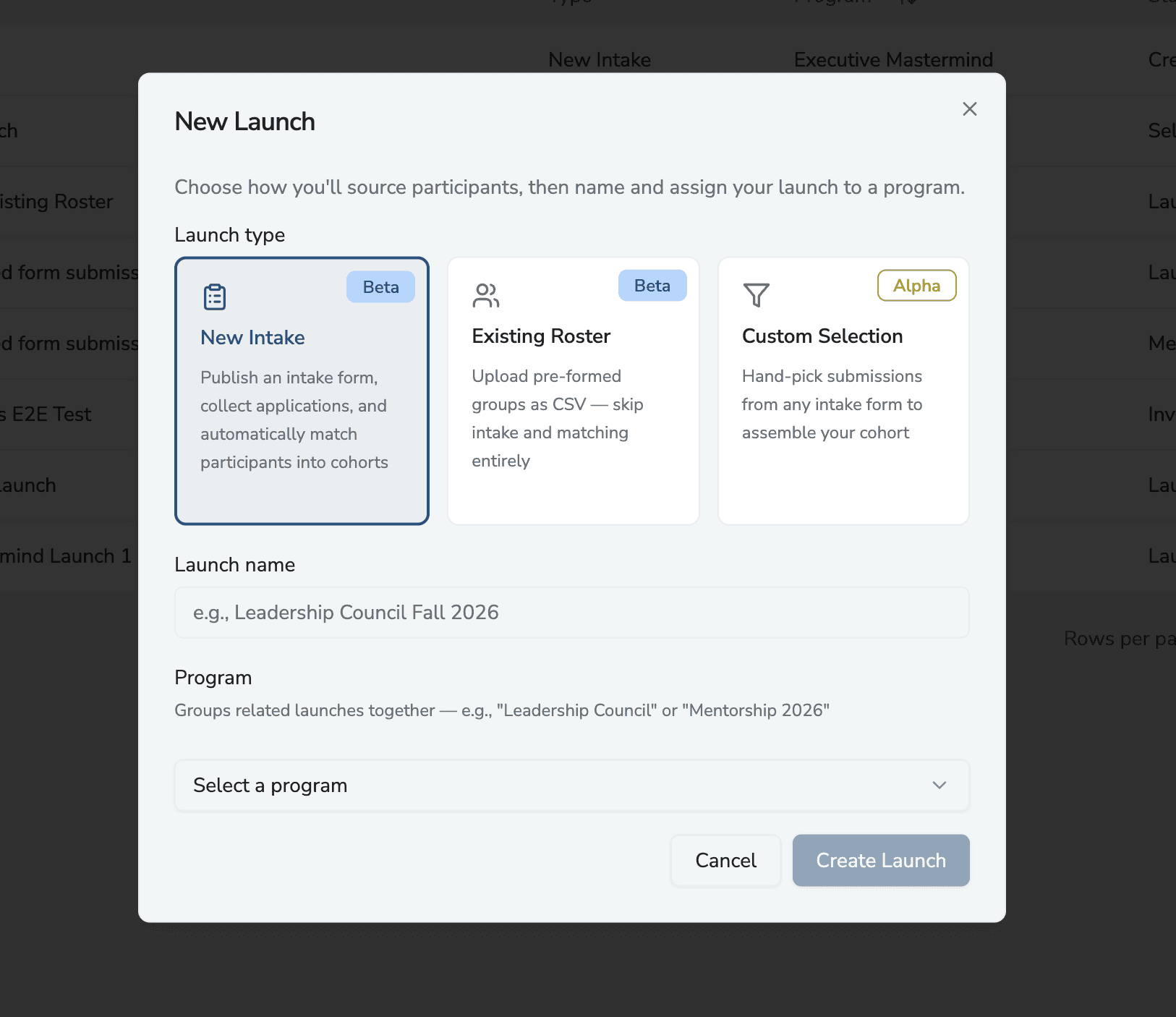
Most associations will live in the first two for now. Custom Selection is intentionally earlier-stage — we'll open it up more broadly as we learn how teams want to use it.
2. Launch an existing roster in minutes
For many associations, matching isn't the bottleneck — coordination is. Committees are already staffed. SIGs are defined. Chapter leaders are named. The question is how to actually get those groups meeting consistently.
Existing Roster collapses that path to a few steps:
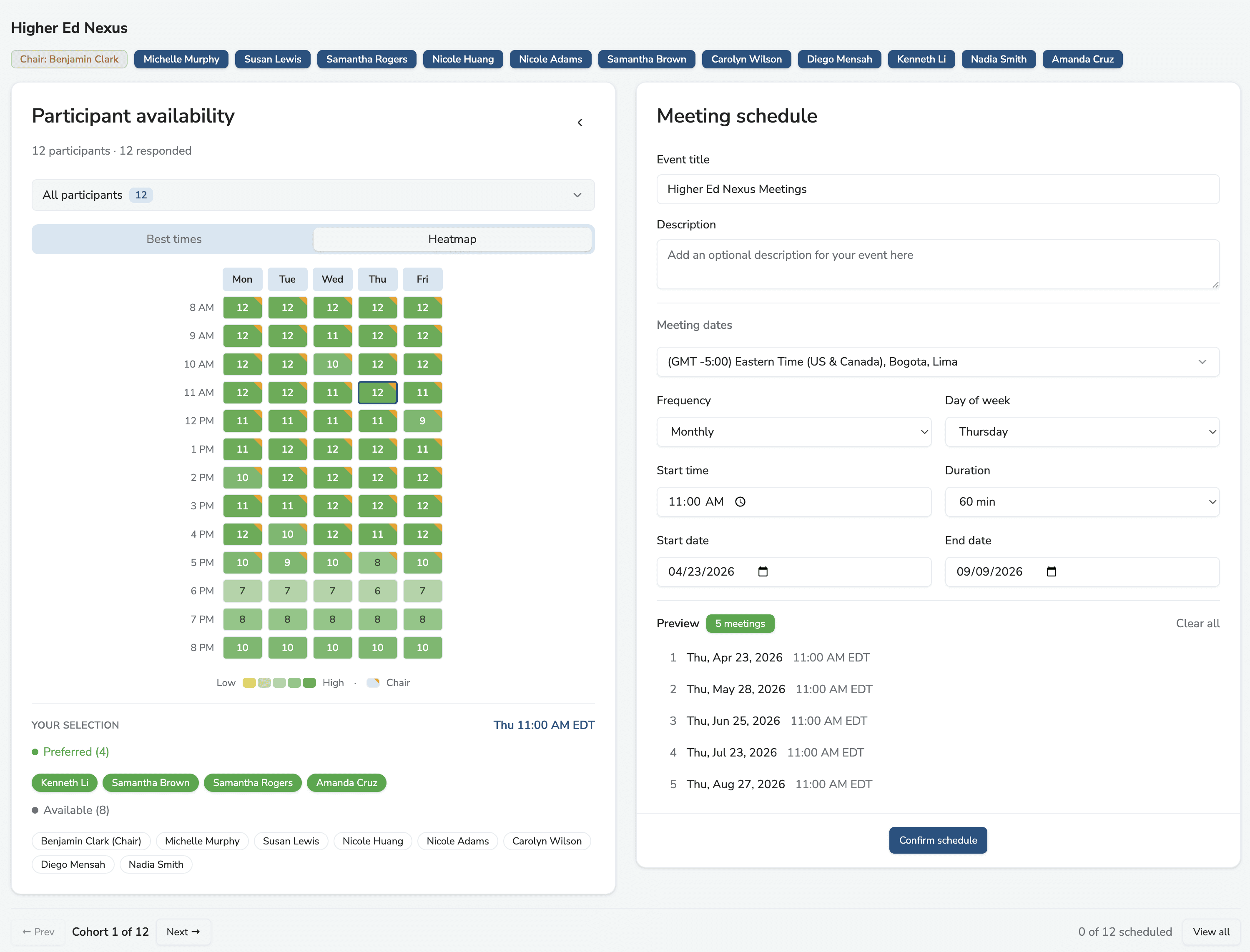
Upload a CSV of pre-formed groups, with members and chairs designated
Optionally collect availability from every member through a lightweight intake form (think: a purpose-built Doodle poll, because sometimes you just need one)
Pick meeting times from a heat map of member availability, or skip scheduling entirely and let chairs self-organize
Configure the calendar invite and onboarding email with a full preview before anything goes out
One deliberate design choice worth calling out: every time RallyBoard is about to send email to your members, we put a checkpoint in front of you — including a 30-second countdown — so nothing goes out without your sign-off. You're in the driver's seat.
3. Calendaring, rebuilt from the ground up
Underneath Launch Center is a new calendar engine, rebuilt entirely by our engineer Clarisse Valera — who spent seven years in product engineering at Lyft before joining us.
As Clarisse put it on the call: calendars look simple on the surface, but underneath there are a lot of protocols and a lot of things taken for granted. Making invites land reliably in Gmail, Outlook, and Yahoo inboxes — without the formatting quirks and deliverability issues that plagued earlier versions — required real engineering work against some genuinely outdated internet standards.
What this unlocks next:
RSVP tracking at the cohort and program level
Scheduling delegation to volunteer chairs
Ad-hoc event formats beyond recurring meetings
The immediate benefit is that the invites just work. The longer-term benefit is that every feature downstream — from RSVP analytics to chair-level scheduling permissions — now has a solid foundation to build on.
4. Form new cohorts with AI matching
For associations launching fresh programs — leadership cohorts, mentorship rounds, peer advisory groups — the New Intake flow handles the heavy lift end-to-end.
Build the intake form. Start from our question bank or write your own. Every question has a "matching field" toggle — the single most important concept to understand when designing an intake form. Only the questions flagged as matching fields feed the algorithm. Our advice: be strategic. Two to four strong matching questions will outperform fifteen diluted ones.
Collect submissions. Share a link or QR code. Submissions populate in a single dashboard where you can filter, segment, and match on a subset (e.g., match 50 of your 150 applicants first, then the next batch later).
Configure the matching run. Before the algorithm runs, you set:
Matching strategy — currently weighted averages; required-field matching is on the roadmap
Cohort size — a minimum and maximum (e.g., 12–16 members)
Optimize for availability — strongly recommended on, since it prevents cohorts from forming that can never actually meet
Auto-assign volunteer chairs — based on who raised their hand during intake
Then you weight your matching questions. In a higher-ed pilot we demoed live, "institutional role" and "institution type" were weighted at 70% each, "enrollment size" at 10%, and "preferred meeting frequency" at 0%. You keep control over every lever.
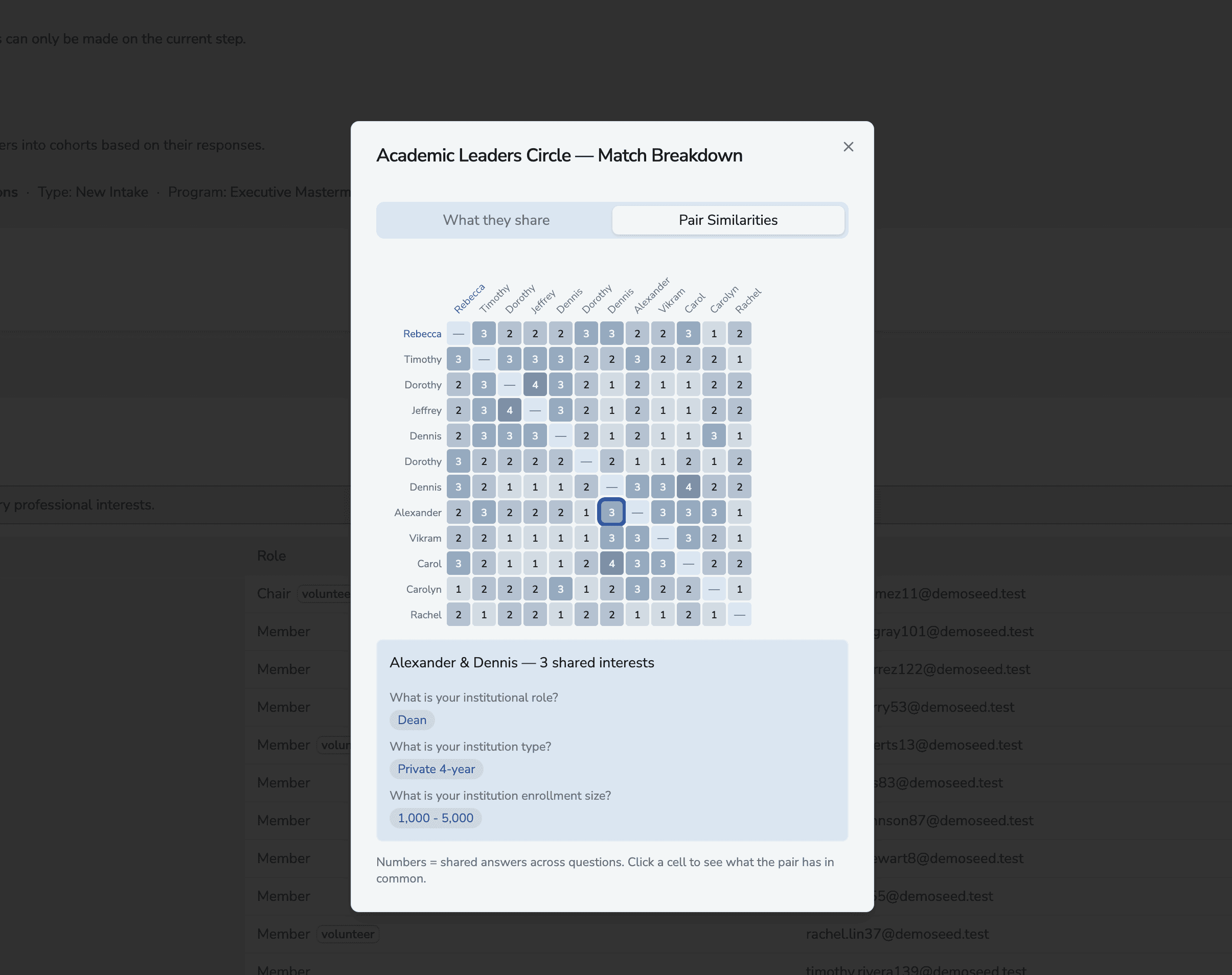
A note on matching scores. The matching score per cohort is not what most people expect. A 30–40% score is actually excellent. A 100% score would mean every member has identical survey responses — which usually defeats the purpose of a cohort. Diversity within alignment is the goal, and the scoring reflects that.
Our engineer Adi Rudra (ex-Blizzard Entertainment, now building this from San Diego) framed the design philosophy around three pillars:
Self-service at scale — go from launching a handful of cohorts at a time to (ideally) hundreds
Matching that feels magical — as Adi put it on the call, even Dumbledore offloaded sorting to a magical hat; you whisper what matters, and the hat does the work
Granular control when you want it — hand-tune individual matches, shift proposed meeting times, swap chairs, and make micro-adjustments before anything goes live
Manual overrides matter. The cohort view lets you drag a member into a different group, compare two members side-by-side on shared attributes, and read an AI-generated summary of why each cohort was formed the way it was. You decide when the match is right.
5. Introducing Signals (beta)
Every cohort meeting generates a rich stream of qualitative context — what's working, what's resonating, what members are struggling with. Historically, capturing that intelligence required post-meeting surveys that most members never completed.
Signals captures anonymized feedback from cohort meetings and surfaces it as trends at the program level.
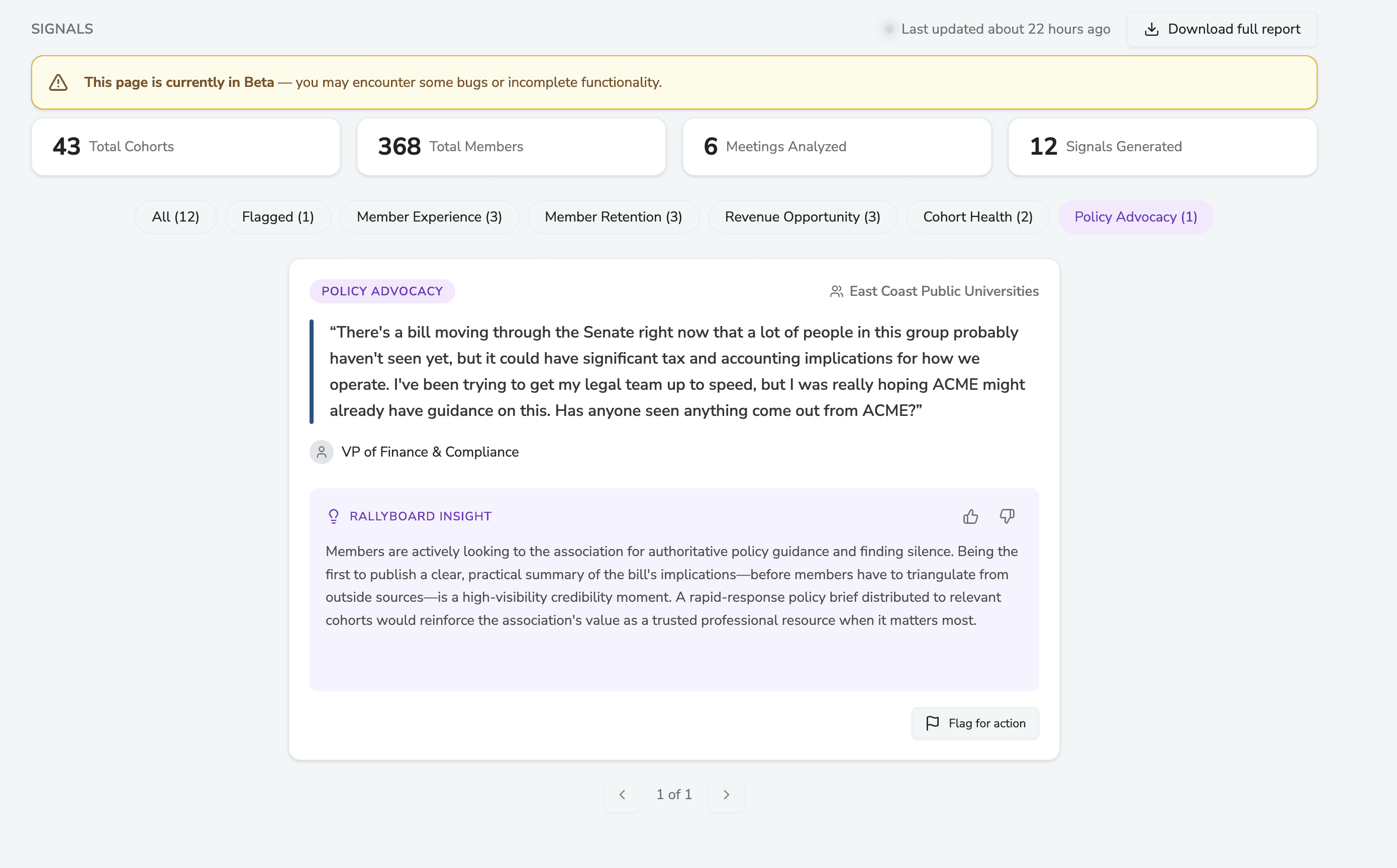
A few principles we've been careful about:
Anonymized by design. Associations see patterns, not individuals. Role-level context may appear (e.g., "a chief of staff mentioned…") but never who.
Member privacy over staff convenience. We do not want to be the big brother of association communities. Every Signals feature is weighed against that line.
Association-useful, not association-watching. The insights we surface are meant to inform programming, services, and advocacy — not to monitor member behavior.
What you'll see: trends like members discussing new legislation, funding pressures, or service gaps — surfaced in the language of your members, with light context on why it might be worth a follow-up. Thumbs up or thumbs down on each insight. Flag ones worth acting on. Download full reports for your board or team.
Signals is in beta for existing customers. We'll be dropping test signals into your dashboards over the coming weeks — tell us what you think.
The roadmap: three frames for the next six months
Finally, our CTO and co-founder Mike Kuo walked through where we're heading next. Three frames, each corresponding to a different person in the RallyBoard experience.
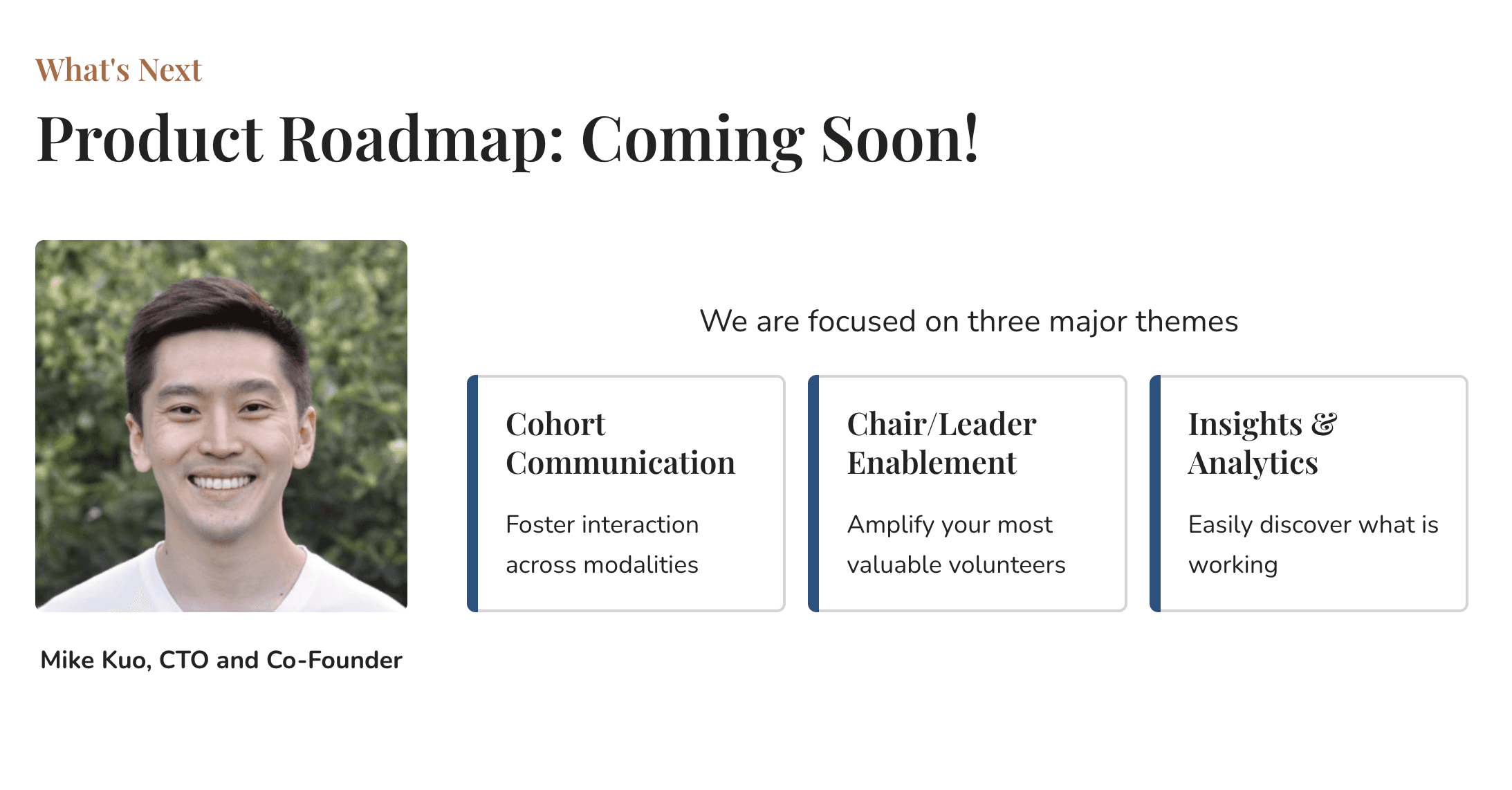
For members — cohort communication. Members move across email, SMS, Zoom, and in-person, and today each of those is a different conversation. We're building a unified conversation layer where any channel feeds into a single thread and posts are pushed back out to every channel. Members can write in email and get replies in Zoom chat; chairs can post once and reach everyone, everywhere.
For chairs — chair enablement. We've been running experiments over the last two months where chairs receive pre-drafted, personalized messages to send to their cohorts. The results have been strong — chairs are adopting the drafts, customizing them heavily, and using them to create the kind of touchpoints that turn a cohort into a community (including members suggesting in-person meetups off their own initiative). Expect more here: personalized member dossiers so chairs arrive prepared, recommended kickoff emails, and more admin controls for scheduling and meeting permissions.
For staff — insights and analytics. We've built a lot of internal tooling over the past year to understand what makes cohorts work. We're now thoughtfully exposing that to you. One example raised on the call: visibility into members who haven't joined their first few meetings, paired with a recommended action — a check-in email from staff or an outreach prompt to the chair. The aim is to close the loop from signal to action without dumping raw data in your lap.
Closing Thoughts
None of what shipped today would exist without the design partners who trusted us early. Your feedback — generous, honest, and sometimes hard to hear — is what got us here. Thank you!
We're excited for what comes next: more associations running cohort-based programs, more members connecting with peers who matter, and a platform that gets sharper with every release. This is the worst RallyBoard will ever be. We're just getting started.