Associations
Stop Building a Destination. Start Owning the Relationship
Why the age of AI agents makes your branded community platform the wrong bet, and what to build instead.

Jackson Boyar
Co-Founder and CEO
·
8 min read

For the last decade, the pitch to associations has been remarkably consistent: buy a beautiful community platform, give it your logo, and members will finally have a home of their own. Own the destination, own the engagement.
It was never quite true. Now it's becoming the wrong strategy entirely.
Two forces are converging. The first is old: members were never going to adopt the new behavior a destination platform requires. The second is new: in an age of AI agents, owning the interface matters far less than it used to. Put together, they point to a different conclusion than the one most associations have been sold. The advantage was never in owning the place members log into. It's in owning the relationships that happen there.
The interface was always a fragile thing to own
Start with what's changing fastest, because it reframes everything else.
The entire value proposition of a destination platform rests on one assumption: that being the place where interactions happen is itself valuable. Own the real estate, own the interaction. That assumption is now eroding in real time.
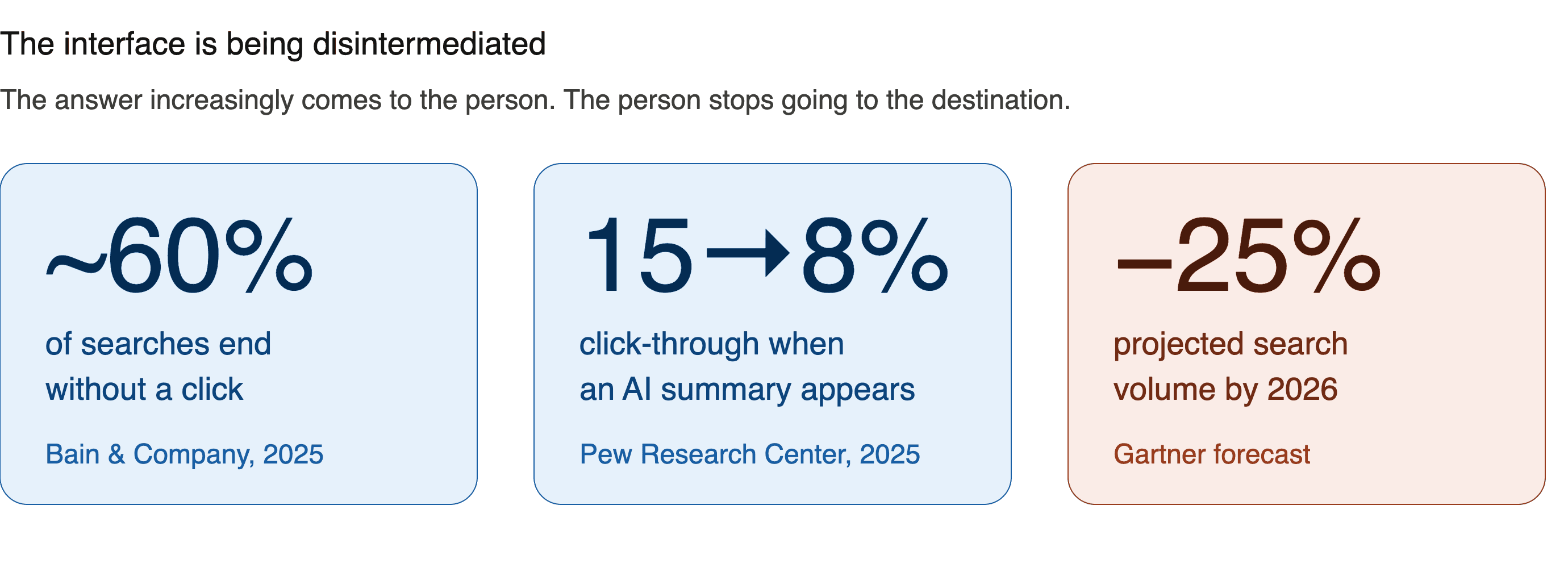
The clearest signal is in search, the original "owned interface" of the web. Gartner predicts traditional search engine volume will drop 25% by 2026 as users shift to AI chatbots and virtual agents, with organic search traffic projected to fall by half or more by 2028. (These are forecasts, and they have skeptics, but the measured data already points the same direction.) Bain & Company found that roughly 60% of searches now end without the user clicking through to any destination at all. And in a Pew study tracking nearly 69,000 real searches, users clicked a result only 8% of the time when an AI summary appeared, versus 15% when it didn't. The answer increasingly comes to the person. The person no longer goes to the destination.
This is not a search story. It's a structural one. Andreessen Horowitz frames it simply: people will start interfacing with the web through their agents. When an agent can summarize a discussion, surface the right connection, or pull the relevant resource, the branded portal that used to be the point of contact becomes one more layer the agent routes around.
So what holds value when interfaces are commoditized? The relationship underneath them. This isn't new thinking. A decade ago, Aggregation Theory argued that the companies who win do so by owning the customer relationship, not by owning any particular distribution channel. McKinsey now calls the same shift in the agentic era a paradigm shift, where durable advantage migrates to whoever owns the relationship rather than the screen. UC Berkeley's California Management Review puts it more bluntly: as AI agents begin to filter information, synthesize alternatives, and execute transactions, firms are no longer guaranteed to interact with customers directly.
For associations, this should be clarifying. Owning the interface was always a strategy you were going to lose at. Owning the relationships is a strategy where you hold every advantage.
The friction tax: an old problem the platform era never solved
The agentic shift is the new reason to rethink the destination model. But there's an older, simpler reason it was never working: the friction tax.
A destination platform asks members to perform a behavior they don't already have. Remember that the association's community lives on a separate site. Navigate to it. Log in, often through a cumbersome single sign-on or a forgotten password. Click through two, three, four, sometimes more layers to reach the right group. Then write something, and hope someone is there to respond.
Every one of those steps is a tax. And we know from outside the association world that the tax is real and quantified. Sixty percent of consumers have abandoned an online purchase because of a password problem. Roughly a quarter of users abandon an app after a single use. Even the most frictionless professional network on earth runs into this ceiling: LinkedIn has well over a billion registered members, but only about one in four are active in a given month. If LinkedIn, with its one-tap login and billions in market spend, converts only a quarter of members to monthly use, what should a niche association portal realistically expect?
The participation research has been consistent for twenty years. The 90-9-1 rule holds that in online communities, 90% of users never contribute, 9% contribute occasionally, and 1% account for nearly all the activity. The independent Community Roundtable softens that to roughly a 55-25-20 split, but only after normalizing for the small share of members who log in at all in a given month. The honest read across both: most members will never actively participate in a destination forum, no matter how good it looks.
Association-specific data confirms it. ASAE reports that as many as 80% of online communities fail, most often due to low engagement, and that in some cases up to 70% of users never even log in.
Here's the detail that should settle the debate. The leading community platform vendor's own data shows that its email digests dramatically outperform its platforms. Higher Logic reports community digest emails open at 56%, against a 36% average for typical association email, while the largest communities see only about 10% of users log in monthly. Read that again. The value members actually extract isn't from visiting the destination. It's from the email that tells them what happened there. Even the platform's own numbers say the engagement lives in the inbox.
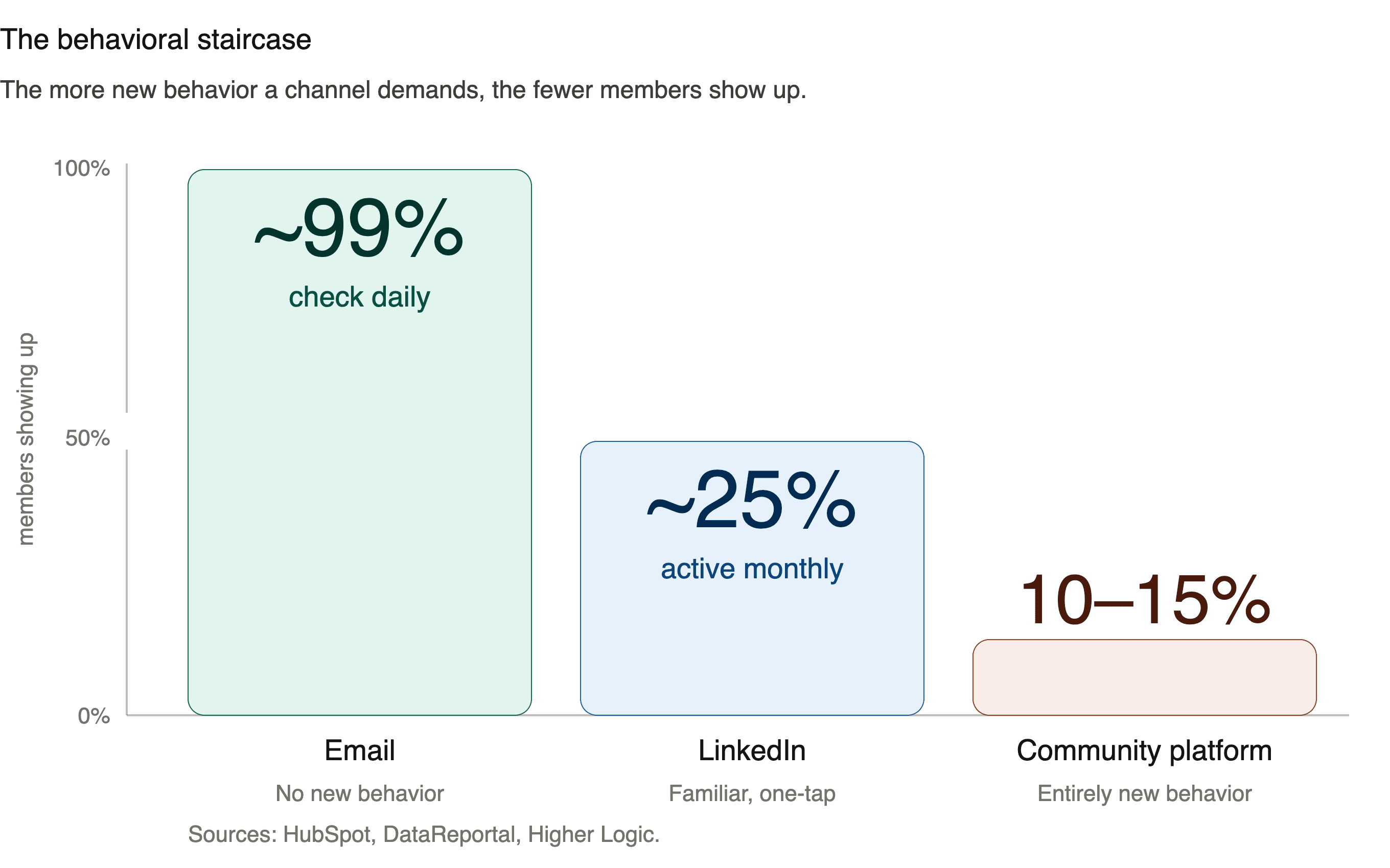
The pattern is hard to miss. The further a channel sits from a member's existing habits, the fewer of them show up. Email is something professionals already do; roughly 99% of them check it every day, many several times a day. A destination platform is something they have to be trained to do. One channel rides an existing behavior. The other tries to manufacture a new one.
When a platform fails this way, it doesn't fail neutrally. An empty community is worse than no community. A discussion board with sparse activity signals abandonment to every prospective member who visits, and increasingly it becomes a distribution channel for the consultants and vendors trying to reach your membership, rather than a space for peer-to-peer learning. The silent graveyard does real brand damage.
Why associations keep making the bet anyway
If the destination model fights both human behavior and the direction of technology, why is it still the default?
Because it's appealing for reasons that have nothing to do with member outcomes. A branded platform puts the association's identity in front of members. It promises to own the interactions. It looks modern and complete in a procurement deck. The promise of a beautiful new platform is what compels the spend.
But manufacturing a new behavior is a genuinely hard, expensive thing to do, and most associations underestimate it badly. Consider Reddit. Before it went public it had raised hundreds of millions of dollars, and even Reddit wasn't inventing a new behavior. Online forums already existed. To earn the right to be the place people go, Reddit poured years into SEO so Google would point to its threads, and ultimately spent enormous sums building market awareness. The average association cannot run that playbook, even with a far more targeted audience. Expecting members to adopt a brand-new destination habit is asking your association to win a fight that companies with billion-dollar war chests barely win.
There's a simpler path hiding in the association's own name. The job is to help members associate. The strategy should be to make that as frictionless as possible, not to build a new place and hope they learn to visit it.
Three shifts worth making
1. Meet members inside behaviors they already have
The most reliable engagement comes from leaning into established behavior rather than inventing new behavior. This is the lesson from nearly fifteen years of building mentoring and community technology. At Mentor Collective, the strongest outcomes came when mentors and mentees connected during college orientation or over simple text-message relays, because students were already going to orientation, and everyone, regardless of age, already texts.
The same principle applies here. Nearly everyone now knows how to join a Zoom meeting, a behavior the pandemic made universal. Nearly every professional lives in their email inbox. A recurring meeting that lands on a member's calendar and a conversation that arrives in their inbox both ride behaviors that already exist. You can layer a modern interface on top of that, accessible through a single magic-link click with no password to remember, but the point is that engagement shouldn't depend on members adopting anything new.
2. Stop owning the interface. Start owning the relationship.
This is the shift the agentic era makes urgent. The strategic asset is not the screen members log into. It's the relationships the association can cultivate and the trust it holds.
Consider what one curated connection is worth. A membership coordinator introduces an emerging professional to a more senior committee member who becomes a genuine mentor. That single act can anchor thirty years of membership. No platform real estate was required. No member had to log in and hunt through a directory. The association did the proactive work of connecting two people, and the relationship is the thing that endures, regardless of which interface, or which agent, mediates it later.
3. Curate proactively instead of waiting for members to come find each other
Open forums put the entire burden on the member: find the right group, show up, post, and hope for a reply. Proactive curation flips that. Instead of waiting for members to discover one another inside a platform, the association assembles small groups, makes the introduction, drops the meeting on the calendar, and gives the connection a reason and a structure to exist.
The evidence that curated, higher-touch connection works is strong. YPO, the global organization of more than 34,000 chief executives, is built almost entirely on small, confidential peer forums. No revolutionary technology, no sprawling content library, just structured human connection, and it sustains roughly a 95% annual renewal rate even at memberships priced between ten and twenty thousand dollars a year. The lesson isn't the technology. It's the curation.
What to do today
Associations don't need a platform decision to start. Teams must move engagement efforts toward behaviors members already have.
If you have next to no budget: Start a listserv or a Google Group around one real, specific member need. Not a general "community," but a defined group with a reason to talk. The listserv has survived thirty years for exactly one reason: it rides the behavior every working professional already performs daily, while almost none of them log into your community platform daily. That's the whole difference.
If you want something higher-touch: Pick one small cohort, eight to fifteen members, around a shared interest or career stage. Drop a recurring Zoom on their calendars. Send the conversation to their inboxes. Remove the login entirely. Then measure attendance and retention, not logins and page views.
Regardless of budget, do this first: Make one curated introduction this week. Connect a member to the right peer or mentor by hand. That single relationship will teach you more about engagement than any analytics dashboard, and it's the kind of value no agent can disintermediate.