Member Engagement
The Case for Cohorts, in Four Pictures
Four simple illustrations explain why small, structured peer groups, not big rooms, static directories, or content feeds, are how associations actually build member engagement.

Jackson Boyar
Co-Founder and CEO
·
12 min read

Every association wants to grow, and growth is supposed to be the win. More members means more dues revenue, more influence, more weight behind an advocacy agenda. But there's a tension baked into that ambition that rarely makes it into the strategic plan: the bigger a group gets, the more anonymous it feels to the person standing inside it. A birthday party with 12 guests feels warm. The same party with 400 people feels like a wedding reception you weren't sure you were invited to. An annual meeting works the same way. Past a certain size, scale itself becomes the barrier to belonging, the very thing associations are trying to grow their way past.
I felt this long before I ever thought about associations. I went to a state university with 40,000 students, and for the first few weeks it was nearly impossible to make a single friend. What changed it wasn't the size of the school getting smaller. It was getting placed into a small orientation group, moving into a dorm floor, sitting in the same 25-person seminar three times a week, showing up to the same club meeting. Each of those was, in effect, a cohort: a small, defined group with a built-in reason to keep seeing the same faces. The university never got smaller. My experience of it did.
That's the tension every growing association eventually runs into, and it's what these four illustrations are really about. The human brain has a hard limit on how many relationships it can track, and most associations are built to broadcast to a group many times larger than that limit allows. Add a content feed doing the same thing to every professional's attention span, and you get the paradox associations live inside every day: more channels, more content, more "engagement opportunities," and members who feel less connected than ever.
Four simple pictures explain why, and what to do about it. Each one contrasts what most associations default to with what a structured, cohort-based approach looks like instead. Together they make the case for peer learning over broadcast, and for member committees, mentoring groups, and special interest groups as the actual mechanism for member engagement and member retention, not a nice-to-have layered on top of it.
Illustration One: Dunbar's Number and the Math Your Association Is Ignoring
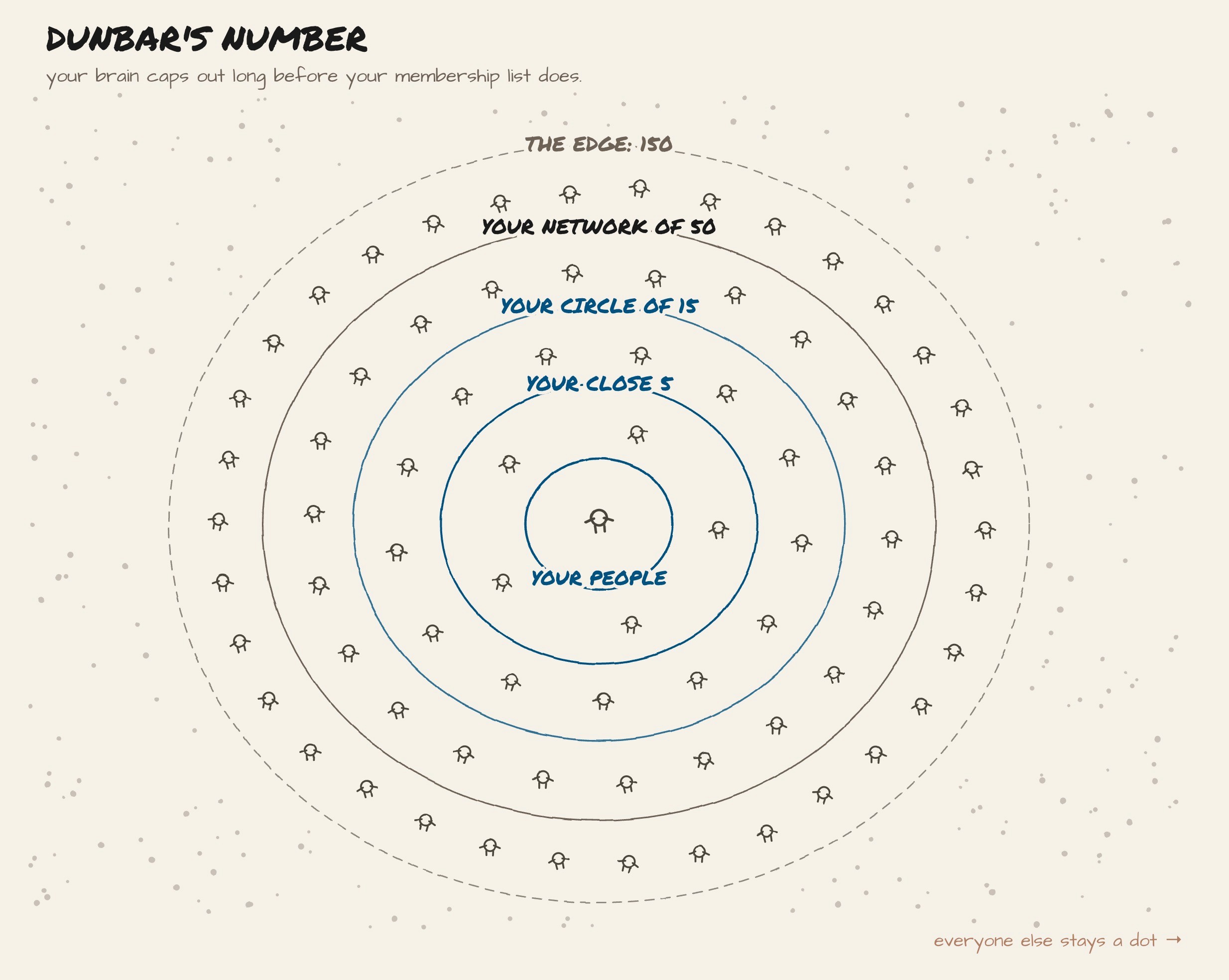
Dunbar's Number is the idea, first proposed by anthropologist Robin Dunbar, that the human brain can only maintain a limited number of stable social relationships, roughly 150. The number itself gets most of the attention, but the more useful part for an association is the structure underneath it. Dunbar's later research describes relationships as sitting in nested layers: a support group of about 5 people you'd turn to in a crisis, a sympathy group of about 15 you'd call for real advice, a wider circle of 50 you'd invite to a big life event, and an outer layer of 150 you'd recognize by name at a conference. Past that, people become faces without context.
Your membership is not 150 people. It's 5,000, or 50,000, or in PMI's case, 700,000 people across 190 countries. No individual member's brain is built to process an organization at that scale, and no amount of better content or a slicker app changes that constraint. It's worth noting that not every researcher agrees the number 150 itself is precise. A 2021 reanalysis argued the original math produces confidence intervals too wide to call it a hard ceiling. But the layered structure, the idea that people invest differently in an inner 5 than an outer 150, holds up regardless of where exactly the outer edge sits.
This is the root cause behind a problem every membership team has felt: engagement plateaus no matter how much content gets published. If an association's only mechanism for connection is broadcasting to the full list, whether by newsletter, community post, or all-member email, it's asking every recipient's brain to do something it structurally cannot do: hold a relationship with a crowd. Past the outer edge of 150, everyone else stays a dot, no matter how good the content is. The alternative isn't more communication. It's shrinking the group down to a size a person can actually process, which is the entire logic behind a mentoring cohort, a chapter roundtable, or a committee of 8 instead of a list of 8,000.
Illustration Two: The Anonymous Room
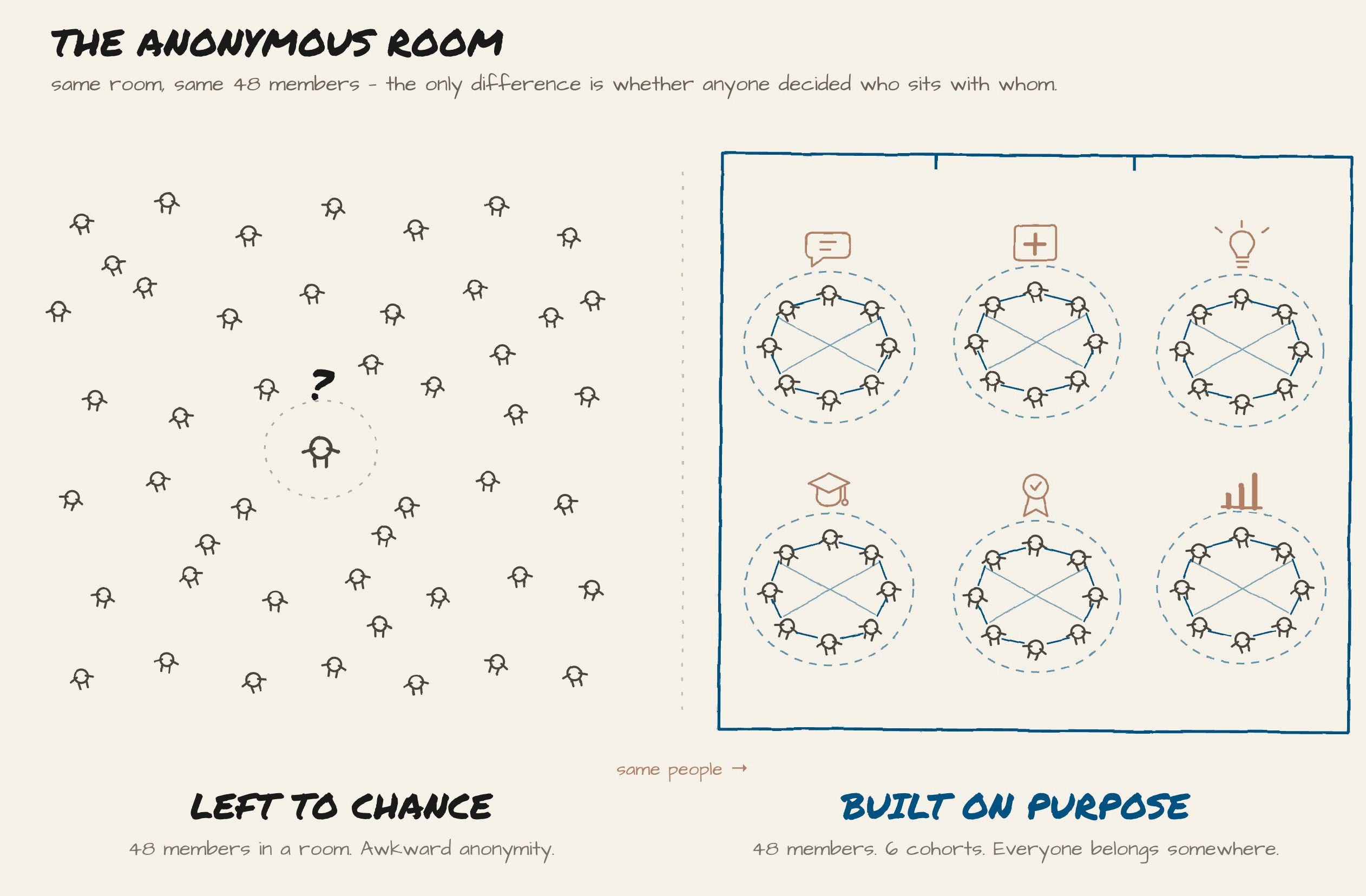
Networking is the reason most people show up to association events in the first place. In a survey of roughly 9,000 conference attendees, 76 percent named networking a top reason for attending, right alongside education. And yet most events hand that goal over to chance: a badge, an open bar, and a room full of strangers hoping the right person happens to be standing nearby.
The problem isn't the size of the room. It's what happens inside it. Decades of social psychology research on group behavior show that individual participation and effort measurably decline as group size grows, a pattern researchers call social loafing. Picture a room of 48 members left to chance. They scatter, and the honest odds that any two relevant people find each other round down to nearly zero, question mark included. Organize the same 48 people into 6 cohorts of 8, each built around a shared interest, and the math flips entirely. Every person now has a defined reason to talk to the seven people next to them instead of scanning a crowd of 47 strangers.
This is why the strongest event formats don't try to make the big room feel smaller. They build small rooms inside the big one. HFMA's approach to matching volunteer leaders is a useful proof point here: rather than leaving regional leadership connections to chance at a single annual gathering, HFMA used structured, matched small groups across regions and priorities, generating real conversational insight the association could act on year-round, not just once a year. The lesson generalizes past any single event: a conference doesn't create connection. The group inside the conference does.
Illustration Three: The Directory vs. the Cohort

A directory is a list of people who might be relevant to you. A cohort is a group of people already talking about something relevant to you, that you can simply join. That distinction matters more than it sounds.
A directory of 1,400 names gives a member exactly one action: search alone, then hope for a reply. A cohort dashboard showing a Nonprofit Finance Leaders group of 8 meeting Thursdays at 3pm, or a Certification Study Group of 6 meeting Tuesdays at noon, complete with a join button, gives a completely different action: just show up. One requires a member to do the work of building a relationship from zero. The other hands them a relationship already in progress.
Start with what actually happens inside most online community platforms. Community Roundtable's research found that while social media engagement typically runs well under 5 percent of followers, close to half of community members self-report as actively engaged, a promising number on its face. But measured behavior tells a more conservative story: Higher Logic's benchmarking of actual association platforms found only about 15 percent of community members are active within a 120-day window. Even a well-built directory or discussion board still puts the entire burden of finding, messaging, and following up on the member. A perfect search result is still a cold outreach problem, and cold outreach converts poorly almost everywhere it's been measured.
Now compare that to what happens when the group is already assembled and the topic is already set. This isn't a small effect. A landmark meta-analysis of 225 studies in the Proceedings of the National Academy of Sciences found that active, structured group participation cut failure rates from 33.8 percent under passive formats to 21.8 percent, meaning people in passive formats were about 1.5 times more likely to disengage entirely. On the flip side, a nine-year tracking study published in Science found completion in large-scale passive online courses stuck stubbornly around 3 percent, no matter how much the platforms improved. Cohort-based formats built around live, small-group facilitation report completion rates closer to 85 to 97 percent by comparison.
PMI's group mentoring pilot is a direct illustration of this gap. Rather than publishing a searchable mentor directory and hoping for matches, PMI used AI-assisted matching to build cohorts of 6-10 members across timezones and career phases, producing the largest mentoring program in the organization's history within a year, the same logic behind a certification-focused study cohort: members preparing for the same credential, on the same schedule, rather than 700,000 names in a search bar. The difference wasn't a better search filter. It was replacing "go find your people" with "here are your people, already in motion."
Illustration Four: Content vs. Connection
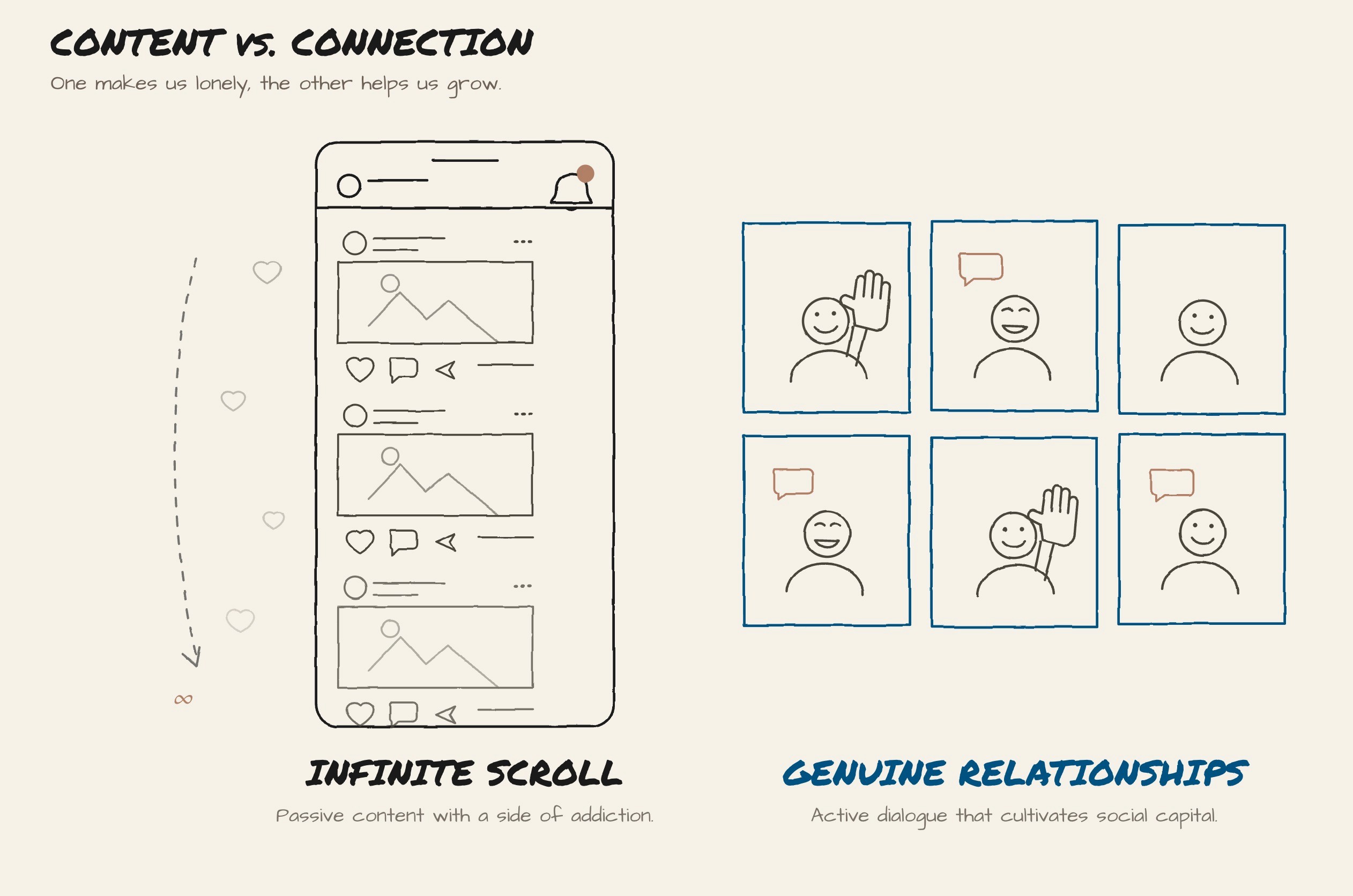
This is the illustration that explains why the first three matter. Associations have spent the last decade competing for attention in a content war they were never built to win, and they've largely lost it. LinkedIn, TikTok, and Reddit have more engineers, more data, and more finely tuned feed algorithms than any association will ever build. Trying to out-content those platforms is a losing strategy on its own terms.
The distinction is simple once you see it drawn out: an infinite scroll is passive content with a side of addiction. A video call full of people actually talking to each other is active dialogue that builds what researchers call social capital, the accumulated trust and mutual value that comes from real, reciprocal relationships rather than one-way consumption. A feed can hold someone's attention. Only a real conversation builds social capital.
But content and connection aren't the same product, and the data on what each one does to people is not subtle. The U.S. Surgeon General's 2023 advisory on loneliness found that Americans now spend about 20 minutes a day with friends in person, down from 60 minutes two decades ago, with the sharpest drop among people under 25. A nine-year longitudinal study published in Personality and Social Psychology Bulletin found that passive social media use specifically predicts rising loneliness over time. Meanwhile, the research on what actually builds a bond points the other direction entirely. An experiment published in the Journal of Experimental Psychology found that voice-based conversation created significantly stronger connection than text, even though most people wrongly predicted it would feel more awkward. A separate study on communication and bonding found the strength of a relationship tracks a clear hierarchy: highest in person, then video, then audio, then text.
That hierarchy is the whole argument for cohorts in one sentence. A newsletter or a discussion board sits at the bottom of that hierarchy no matter how well it's written. A live, small, recurring group conversation, the kind that happens inside a mentoring cohort or a committee meeting, sits at the top. Associations don't need to win the content war. They need to stop fighting it and lean fully into the one thing a feed algorithm cannot replicate: real, synchronous, human participation.
Make the Big Feel Small
Growth and belonging don't have to be at odds, but only if an association treats the anonymity of scale as a problem worth solving, not a side effect of success. My university didn't get smaller to make me feel like I belonged. It got structured. An orientation group, a dorm floor, a seminar section, a club roster, each one took a fraction of 40,000 strangers and turned it into a dozen people who knew my name. That's the entire idea behind a cohort, and it's deceptively simple: give members a small, defined group of peers instead of one enormous membership roll, and belonging tends to follow on its own.
If I ran an association, I'd try to build a version of that orientation group into every stage of the member journey, not just once at onboarding. The alternative is a membership base that keeps growing on paper while feeling like less and less of anyone's actual community, until there's no longer enough connection left to keep people around. A few places to start:
Pick one committee, chapter, or program and cap group size at 6-10. Not a mailing list. A group small enough that everyone in it can actually track who the others are.
Stop measuring success by reach and start measuring it by participation. A webinar with 800 viewers and a cohort with 8 active members are not the same kind of engagement, and only one of them builds a relationship that survives past the event.
Give members a reason to join a conversation already in motion, not a directory to search alone. If the first step for a new member is "browse and message someone cold," that's the friction to remove first.
Treat your next event as the start of a cohort, not the end of one. A pre-conference or post-conference small group turns a single day of connection into a relationship that lasts the rest of the year.
The associations that figure this out won't win by producing more content or building a flashier directory. They'll win by remembering that growth and intimacy aren't actually opposites, they just require different tools. The tool is the cohort: the small group inside the large one, doing on purpose what my orientation group did for me by accident.