Associations
What Category Does RallyBoard Belong In?
After mapping the association tech landscape and talking to hundreds of leaders, we're naming our category: Peer Learning Platform. Here's why it matters—and why we almost didn't bother.

Jackson Boyar
Co-Founder and CEO
·
5 min read
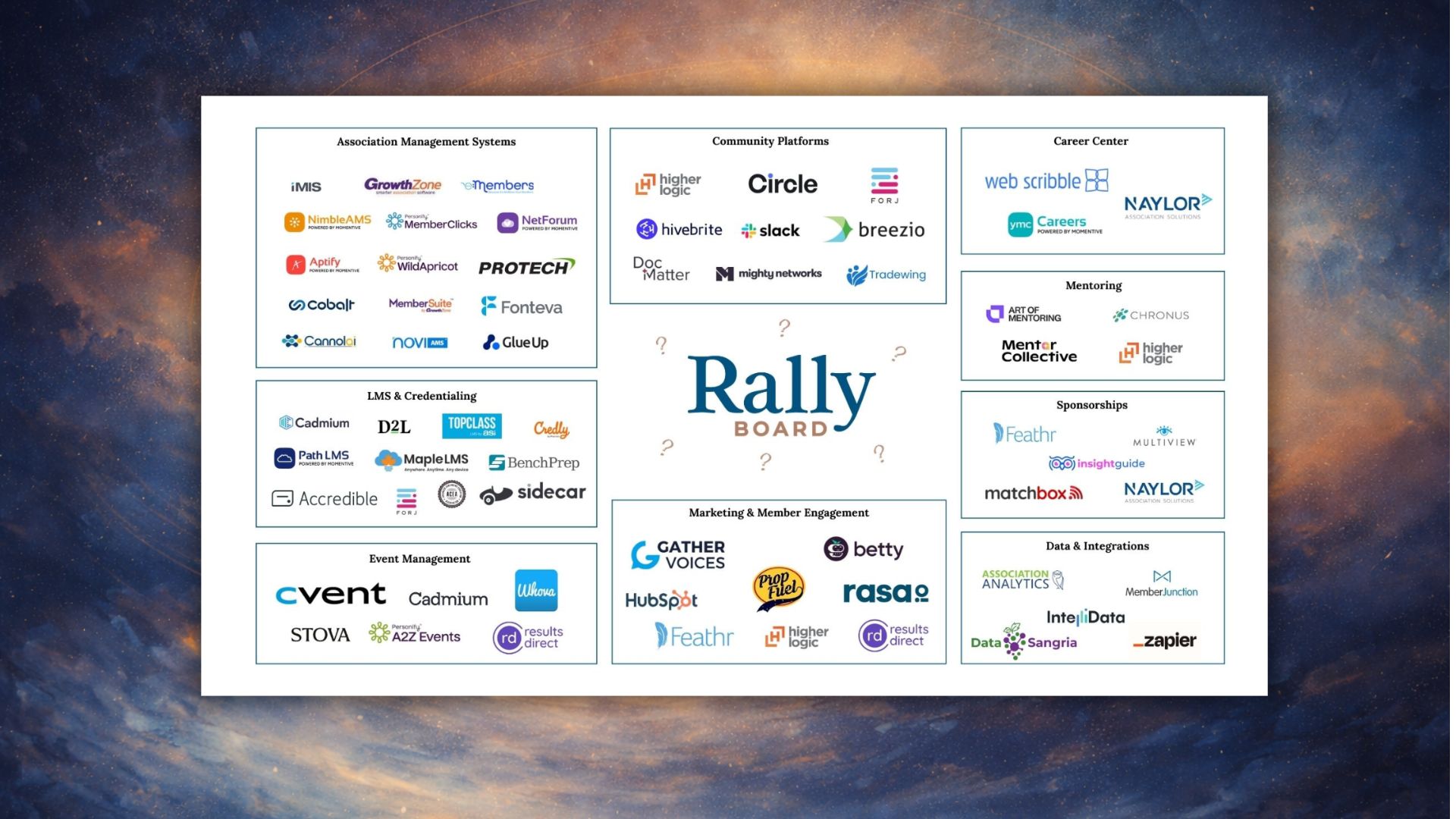
After talking to hundreds of associations over the past two years, I started noticing the same software names coming up again and again. So I did what any founder who probably has better things to do would do: I started mapping the landscape.
What I found was clarifying, humbling, and ultimately beside the point—in that order.
What the association tech stack actually looks like
The first thing that jumps out when you map association technology is the sheer volume of Association Management Systems. There are so many. Someone should commission anthropological research on why associations have generated this many systems of record. It is, genuinely, wild.
The second observation: horizontal tools—platforms built to serve everyone—barely register in this market. Associations want vendors who built specifically for them. Many modern platforms are nearly invisible here because they tried to serve every vertical at once. In a market defined by professional identity and trust, "we serve everyone" is a liability, not a feature.
The third observation is the one that prompted this post: RallyBoard doesn't fit any existing category cleanly.
We touch community, mentoring, and member learning. But none of the existing platforms in those categories overlap with our actual focus: synchronous, cohort-based peer experiences. Community platforms are built for asynchronous many-to-many discussion. Mentoring platforms are optimized for one-to-one matching. Learning Management Systems are designed for self-paced content consumption. Each of those categories is real and valuable. None of them is what we're building.
The use cases that revealed the gap
The clearest signal that we were in new territory came from the use cases our early customers kept bringing to us: committees, group mentoring, special interest groups, annual meeting networking that extends beyond three days, cohort-based professional development programs.
What all of these share is a simple requirement: members want to meet synchronously, as a small group, over time. They want structure without bureaucracy. They want connection without the coordination overhead that typically makes these programs impossible to scale.
You could theoretically jerry-rig a community platform, a mentoring platform, or an LMS to accomplish some of this. The reason it hasn't happened in practice—at scale, across association types—is that none of those tools were designed for it. The use case was never the priority. The workflow was always a workaround.
That gap is exactly where we operate. And watching our first customer, NACU, activate 24 cohorts across their learning communities, with members self-selecting as chairs for the first time without staff prompting, made it concrete: this isn't a feature missing from an existing category. It's a category itself.
How the existing categories fall short
Category | Built for | What it misses |
|---|---|---|
AMS / CRM | Member records, dues, events | Active peer engagement between transactions |
Community Platform | Asynchronous discussion boards | Synchronous small-group accountability |
Mentoring Platform | One-to-one matching at scale | Group dynamics, cohort resilience, broader reach |
LMS | Self-paced content delivery | Peer interaction, live facilitation, cohort formation |
Peer Learning Platform | Synchronous cohort-based engagement | — |
A lesson from Mentor Collective I carry everywhere
Here's something I didn't fully appreciate until I had spent a decade building in this space: the more time you focus on your competition and your market positioning, the less time you spend with your actual customers—who are dealing with real, day-to-day operational challenges that you can either support or ignore.
At Mentor Collective, the periods when we grew fastest weren't when we had the cleanest competitive analysis. They were when we were talking to program administrators every week, watching them run their workflows, and building what solved the next problem they hit. The category almost defined itself from that process.
With RallyBoard, this side quest to map the market is, in some ways, a distraction. We're naming the category because it's useful shorthand—for customers trying to explain what they're buying, for analysts trying to understand what's emerging, for the broader conversation about what associations need next. But the naming isn't the work. The work is the same as it's always been: obsess over the customer.
Why "Peer Learning Platform" and not something else
We could have latched onto an existing label. "Community platform with cohort features" would have been legible. "Group mentoring software" would have captured one dimension. "Member engagement platform" is what half the tools in this space call themselves, which is part of why it means almost nothing.
We chose Peer Learning Platform for a specific reason: it describes what actually happens in a well-run cohort. Members learn from each other. Not from an expert lecturing down. Not from scrolling a discussion thread. From structured conversation with peers who share their professional context, their challenges, and their commitment to showing up next month.
Research on peer-assisted learning has consistently shown that this modality improves knowledge acquisition and professional development outcomes in ways that one-to-many formats don't. A 2024 systematic review in the Journal of Organizational Behavior found that peer development groups in professional settings created psychological safety, reduced burnout, and enhanced leadership development—outcomes that would look remarkable on any member satisfaction survey.
The gap between what associations know about the value of peer connection and their ability to deliver it at scale is exactly the problem we exist to close. "Peer Learning Platform" captures both sides of that clearly enough to be useful.
The naming will probably change
It usually does. Categories get named, then refined, then sometimes renamed entirely as the market matures. When Salesforce started, "CRM" was still contested territory. When Slack launched, "team messaging" sounded redundant—email already existed. The label matters less than the behavior it describes.
What we know is that synchronous, small-group, peer-driven engagement is emerging as a distinct and defensible category in association technology. Associations Now has noted that members value peer learning as much as formal instruction—and that community-powered experiences are increasingly what differentiates association membership from free alternatives.
The associations choosing to invest here—in programs like cohorts, structured committees, peer advisory groups, and SIG-based professional development—are seeing engagement outcomes that discussion boards and webinars simply cannot produce. Marketing General's 2024 benchmarking found that associations seeing membership growth were more likely to have increased engagement budgets and created multiple touchpoints throughout the year—not just concentrated resources on a single annual event. NACU went from several dormant learning communities to 24 active cohorts in a matter of months. Members who had never volunteered to lead anything began self-selecting as chairs. That's not a product feature story. That's a category story.
Three to five years from now, we may call this something different. For now, Peer Learning Platform is the clearest way to describe what we're building and why it doesn't fit anywhere else on the map.
What this means for association leaders
When you're evaluating your technology stack, don't assume that one of your existing tools can be configured to run cohort-based programs at scale. The evidence from associations that have tried suggests otherwise.
Community platforms are excellent at broad-reach, asynchronous engagement. Mentoring platforms are excellent at one-to-one matching. LMS platforms are excellent at delivering structured courses. None of them were designed to automatically schedule recurring small-group meetings across time zones, match members into cohorts based on role and interests, track attendance, and generate AI-powered meeting summaries that keep institutional knowledge alive between sessions.
These aren't features you can bolt on. They're the core infrastructure of a different kind of program—one that delivers the relational value your annual conference creates, extended across all 52 weeks of the year.
That's the category we're building. We're glad to finally have a name for it.