Podcast
Why Associations Keep Surviving Every Tech Wave: David Gammel on Resilience, AI, and Servant Leadership
A two-time association CEO explains why the business model that "makes zero sense" on paper keeps outlasting the technologies predicted to kill it.

RallyBoard Staff
·
7 min read
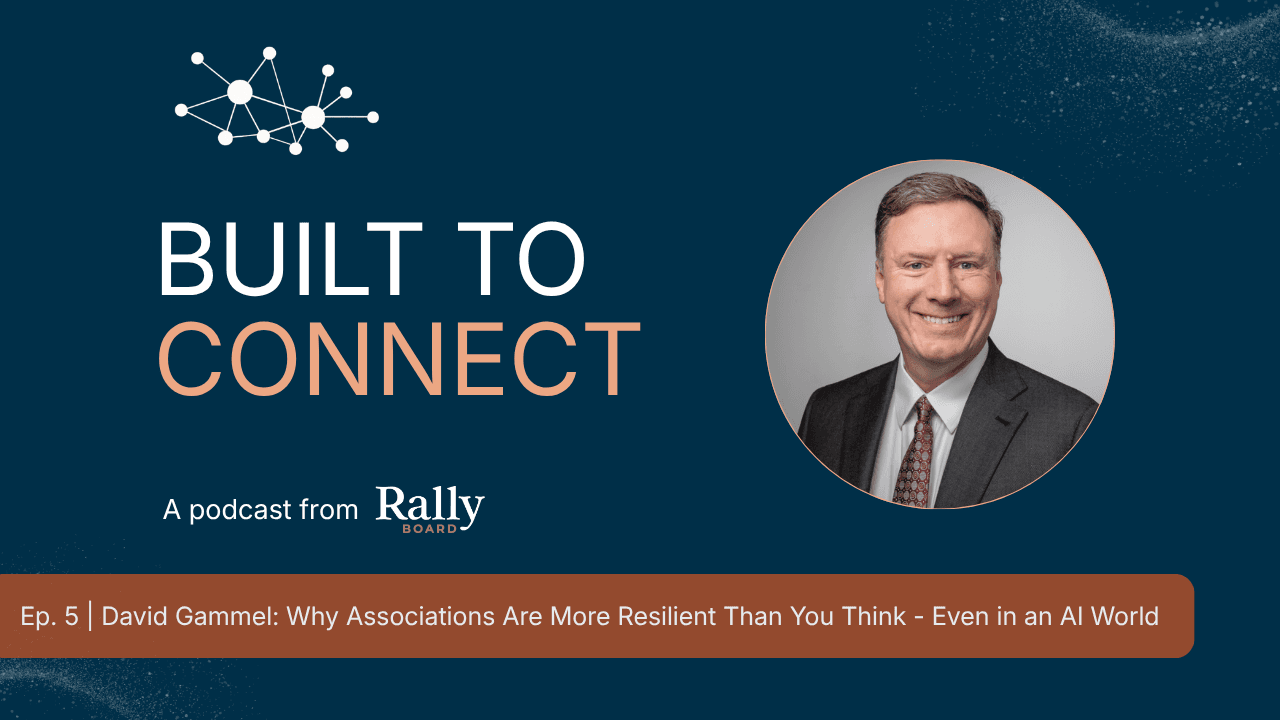
David Gammel has watched the association field from nearly every angle. He spent almost nine years as Executive Director of the Entomological Society of America, returned to consulting as Chief Practice Officer at McKinley Advisors, and now leads the American Association of Physicists in Medicine (AAPM), a 65-year-old organization representing over 10,000 medical physicists across more than 90 countries. He is also a Fellow of ASAE and has served on its board and selection committees.
That back-and-forth between consulting and the CEO seat gives Gammel an unusually grounded view of where associations are strong, where they are slow, and why they keep enduring. On this episode of Built to Connect, he made the case that associations are far more resilient than the doomsayers admit, that the work of leadership is fundamentally about serving other leaders, and that AI is best understood as a way to remove administrative drag without lowering the bar on rigor.
Here are five takeaways from the conversation.
1. The association model survives every technology wave because it does something for-profits and governments won't
Gammel has seen wave after wave of technology predicted to end associations. None of them have.
"My entire career, there's been a lot of technology transformations, wave after wave, and every one of them, they've predicted it's gonna end associations as we know it. And hey, look, we're still here."
His explanation for that durability is worth sitting with. An association, he argues, is a strange creature: a miniature conglomerate that bolts together wildly different lines of business (meetings, publications, membership, standards, certification) under a consensus-based governance layer. Present that as a case study in business school and it would look incoherent. But because an association is nonprofit, formed by and accountable to a community, with any surplus plowed back into the mission, it earns a kind of credibility and license that competitors structurally cannot match.
Why it matters: This is the throughline of RallyBoard's white paper on why associations should stop competing with Big Tech and start scaling what only they can provide. Gammel's framing reinforces the point from the inside: associations win not by out-publishing platforms, but by being the trusted, mission-bound convener of a community. The resilience is real, but it depends on continuing to do the things the model is uniquely positioned to do.
2. Associations are slow by nature, and that can be a feature if you use it well
Gammel is candid that associations lag the broader economy on technology adoption. But he reframes the lag as something to manage rather than lament.
"We're slower, but it also lets us kinda look at how things worked in the broader world, let other folks fail first and kinda bow out on some stuff, and then we can try it."
The trick, he says, is to be cutting edge relative to your own space rather than relative to Silicon Valley. You won't be ahead of the broader economy, but you can be proactive within your discipline by pushing a little harder than peers and not simply reacting once change is forced on you. At AAPM, that is helped by a membership of technologists who are used to their tools getting swapped out every few years and who expect the organization to keep pace.
Why it matters: Most associations don't need to be first; they need to be deliberate. The failure mode isn't moving slowly, it's confusing slow with passive. Starting with small pilots, learning, and expanding from there is exactly the test-and-iterate posture that turned dormant communities into active ones in the NACU case study.
3. AI's biggest near-term win is removing administrative drag without sacrificing rigor
AAPM runs over 400 volunteer groups with a staff of around 29, which means most of those groups operate without direct staff support. Gammel sees AI as a way to move that volunteer and staff work through the process faster, as long as the rigor stays intact.
"How can we make this easier with the same level of rigor? We always have to maintain the rigor, but if there's stuff in there that's just process and is slow ... how can we apply these technologies to help with that?"
He is equally clear-eyed about the risks. He flagged the rise of fabricated citations in published research, including in medicine, as a serious concern: large language models are very good at producing plausible-sounding references that don't actually connect to anything real. The discipline, in his telling, is to deploy AI on the genuinely procedural steps (metadata extraction, tagging, scheduling) while preserving the human judgment that creates the quality.
Why it matters: This mirrors how we think about automation at RallyBoard. Let technology handle matching, scheduling, reminders, and meeting summaries so staff can focus on program strategy and quality. Gammel's "same level of rigor" standard is the right guardrail, and his citation warning is one every association publishing content with AI should heed.
4. Serendipity at your annual meeting can be augmented, not just left to chance
Gammel believes deeply that people still want to convene in person, and that the hallway conversations and chance encounters are where much of a conference's value lives. But he doesn't think that value has to be left entirely to luck.
He pointed to the American Geophysical Union and its SVP of Digital and Technology, Thad Lurie, as the most cutting-edge example he's seen. AGU has used machine learning to mine decades of research papers and presentations to recommend other members each person should connect with, and to help attendees find the most relevant sessions at a meeting with tens of thousands of options.
"These three I've known for my entire career ... but these two I didn't know existed. And then ... she's like, 'I should absolutely be working with these people.'"
That, Gammel said, is "manufactured serendipity": not a replacement for the in-person magic, but a way to surface connections members would otherwise have missed, available only because they belong to the community.
Why it matters: Jackson connected this to a lesson from his decade improving college graduation rates: the people who most need support are often the least likely to raise their hand. The same is true of the long tail of association membership. Removing friction from connection, by curating the handful of peers a member should actually meet, can move the needle on engagement far more than hoping members self-organize. That is precisely the gap structured peer programs are built to close, as detailed in our work on transforming online communities into dynamic cohorts.
5. The best leaders build other leaders, and stay practically optimistic
Asked what exemplary association leadership looks like, Gammel returned to servant leadership, the concept rooted in Robert Greenleaf's work.
"The folks I respect the most are the ones who have an amazing alumni group of folks that have been in their circles at various times and have developed into leaders down the road."
For Gammel, an association is itself an expression of this idea: a community coming together to achieve what its members can't accomplish alone, and in the process generating new leaders on the staff side, the volunteer side, and across the discipline. The measure of a leader isn't a cult of personality, it's whether the organization thrives after they leave and whether the people they touched came out better for it.
His closing recommendation was less about tactics than temperament: stay practically optimistic. Not Pollyanna optimism that makes people tune you out, but a grounded, hopeful tone, because as a leader you set the tone for your board and your staff, especially through hard years.
Why it matters: Technology and tactics matter, but Gammel's reminder is that associations are ultimately human institutions. The leaders who endure are the ones who develop other people and hold onto hope without losing their realism, exactly the kind of two-way, relationship-first orientation that keeps members renewing year after year.
Final thought
Gammel's through-line is reassuring and demanding at the same time. Associations have survived every technology wave because the model does something irreplaceable, but survival isn't automatic. It depends on adopting and adapting: using AI to strip out administrative drag, augmenting in-person serendipity instead of leaving it to chance, and leading in a way that builds the next generation. As he put it, associations will continue to exist, "but we have to adopt, and adapt."
Listen to the full conversation with David Gammel on the Built to Connect podcast, where we talk with association leaders about the future of member engagement.