Podcast
Why the Association Business Model Is Broken: 5 Takeaways from Dr. James Young
Dr. James Young on why the association business model is broken — and what it takes to build one designed for the forever member journey, not the four-day conference.

RallyBoard Staff
·
5 min read
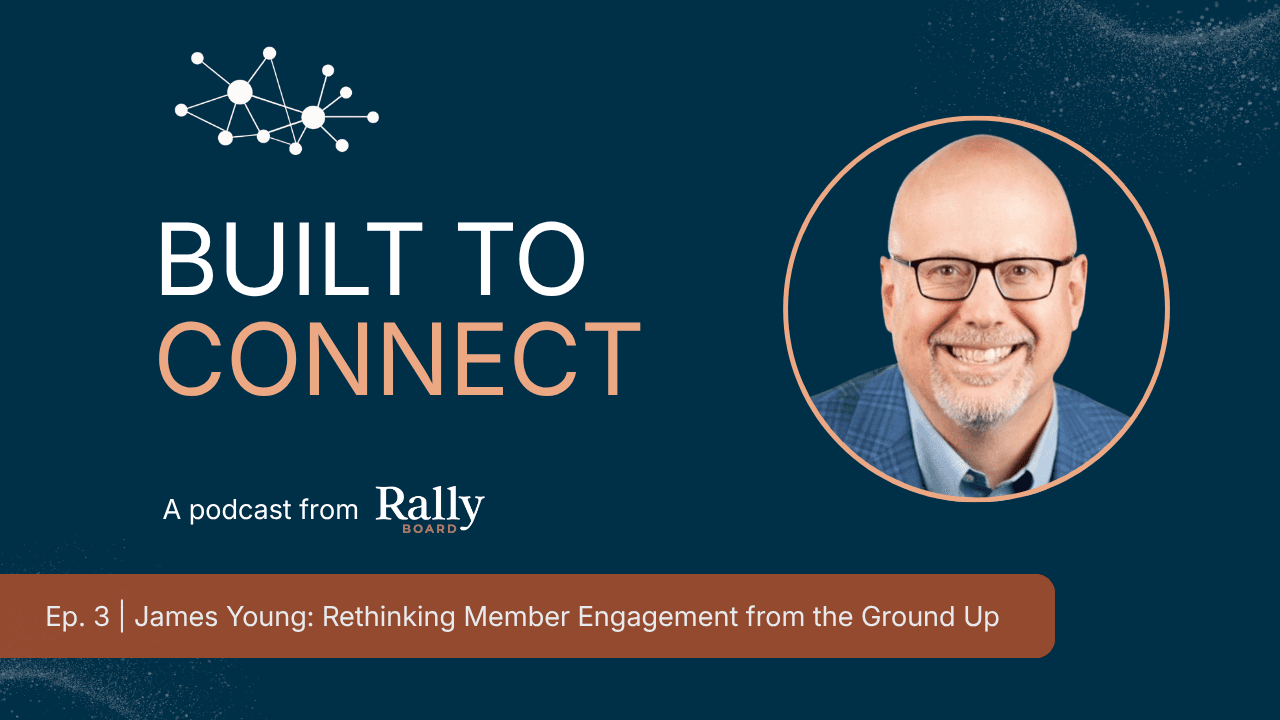
In this episode of Built to Connect, Dr. James Young — two-time Chief Learning Officer and founder of Product Community — challenges the assumption that associations need to incrementally improve and argues that the dominant business model needs to be reinvented from the ground up.
James self-describes as a "subversive" in the association industry. After a career spanning libraries, higher ed innovation, and two stints as a Chief Learning Officer, he started Product Community to help associations co-create value with members rather than broadcast at them.
The conversation covered a lot of ground. Here are five takeaways that should be on every association CEO's desk.
1. The 60/20 Problem: A Business Model Built on Four Days a Year
"What business model, what company, what organization in the world would bank 60% of its revenue on four days out of the year to serve 20% of its customers?"
James's framing of the conventional association model is the kind of question that doesn't get pushback because it's accurate. For most associations, the annual meeting drives the majority of revenue, and the membership fee largely functions as a discount on the event. The remaining 80% of members — the ones who don't attend — are paying for something they're not really using.
The undiversified revenue model isn't just a financial vulnerability. It hems the entire organization in. When the conference is the product, every other program gets starved of resources, attention, and ambition.
Editorial note: This is the structural problem behind every renewal conversation. We've written before about extending the annual meeting into year-round engagement, and our work with HFMA shows what happens when an association builds infrastructure to serve members between conferences.
2. Associations Are Communities of Communities — Not Umbrella Brands
"There's a misnomer out there in our space that when we invest in community, we are investing in an umbrella… When you actually study how communities work, that umbrella is kind of like window dressing."
Investing in "community" at the macro level — a single platform, a single brand identity — rarely changes member behavior. James argues that associations are actually networks of micro-communities: cohorts, communities of practice, special interest groups. Members engage where they find shared identity and a real problem to work on, not where the logo is biggest.
This is also why James is dubious of community software as a solution. The platform isn't the point. The structure underneath it is — small enough groups, with enough specificity, that people actually want to show up.
Editorial note: This is exactly the shift we've seen at NACU, where launching cohorts inside existing learning communities transformed dormant groups into active ones and doubled the number of volunteer chairs without staff recruitment. We've written more on this dynamic in From Discussion Boards to Dynamic Cohorts.
3. Serve Problems, Not Just Professions or Industries
"Trade associations serve industries… professional societies serve professions. I think we should be serving problems."
The world doesn't actually operate by discipline. The members who are most engaged — and most willing to pay for differentiated value — tend to be the ones working at the messy intersections where real problems live.
James's call: stop framing your association as the home of a profession or industry, and start framing it as the place where the most important problems facing your members get worked on. Programming gets sharper, and the people who lean in are the ones with energy to contribute, not just consume.
Editorial note: This is the unrealized potential inside most committees. Done right, committees are problem-solving infrastructure. Done wrong, they're administrative overhead. We dig into the difference in Why Association Committees Are Failing (And How to Fix Them in 2026).
4. There Is Good Revenue and Bad Revenue
"Bad revenue is cash cow revenue… Good revenue sparks more revenue."
James draws a sharp line. Bad revenue is under-diversified — events and passive membership — and it leaves no room to innovate, even when the quarterly numbers look fine. Good revenue, in contrast, is what he calls compound value: distributing engagement across the internal market of passive members, building longitudinal journeys, and creating products that spark more products.
The way most associations escape the cash cow trap isn't a bet-the-farm certification overhaul. It's small experiments. Test two new things this year. Run an innovation cohort across boundaries. Learn what your members actually want before you scale.
Editorial note: Cohort-based programs are one of the highest-leverage compound value plays available to associations, because they activate the passive 80% of members rather than asking the same 20% to pay for more. We mapped the full landscape of engagement strategies — and where each one fits — in Top Member Engagement Strategies for 2026.
5. Stop Serving Members. Serve the Forever Member Journey.
"The old question is, how do we serve members? The new question — and it's a different question — how do we best serve the forever member journey?"
The mid-career, event-anchored model was designed for a different generation. It doesn't reach the 25-to-40-year-old professional who is starting a family, doesn't have discretionary budget, and has every information need met for free by ChatGPT, LinkedIn, and YouTube.
James's reframe: design for the longitudinal journey, not the renewal cycle. That means meeting members where they are at every career stage and making the value compound over time, not reset every year. It also means rethinking who creates value. The forever member journey isn't something staff deliver to passive recipients — it's something members and staff co-create.
Editorial note: This is exactly what PMI is building with cohort-based programs that serve members across credential pathways and career stages, moving from one-time transactions to multi-year relationships.
A Final Thought
The through-line of James's argument is that associations have something only they can offer: the ability to convene the right people, around the right problems, over a long enough timeframe to actually create new value together. None of that requires more content, more emails, or a bigger conference. It requires designing the member experience as if it matters across all 365 days — not just four.
That design challenge is the work ahead.
Listen to the full episode of Built to Connect with Dr. James Young on the RallyBoard podcast page.