Back
Technology

RallyBoard Staff

Most association community platforms promise engagement. Few deliver it. According to Higher Logic's 2024 Association Community Benchmark Report, only 15% of community members are active within a 120-day period, even on well-designed, well-promoted platforms. The problem is rarely access. It is activation.
That gap matters more than ever. The MGI 2025 Membership Marketing Benchmarking Report found that half of associations report flat or declining membership, and only 11% describe their value proposition as "very compelling." When members do not engage, they do not renew.
So when you evaluate a community or engagement platform, the question is not "does it have a forum and a directory?" Nearly all of them do. The real question is: which features actually move members from passive to active, and which ones are just table stakes dressed up in a demo?
This checklist covers the capabilities that separate a platform members use from one that quietly gathers dust. We have organized it into three tiers: foundational features every platform should have, engagement features that most platforms still lack, and operational features that determine whether your staff can actually run the thing.
Use it as an RFP checklist. Bring it to your next demo.
Tier 1: Foundational Features (Table Stakes)
These are the baseline. If a platform is missing any of them, keep looking. But do not mistake them for differentiators. Almost every established platform checks these boxes.
Discussion spaces and groups. Topic-based threads and interest groups where members post and respond asynchronously. The backbone of the community category for over a decade.
Member directory and profiles. A searchable database that lets members find peers by role, geography, expertise, or interest.
Content library. A place to store and organize resources, templates, recordings, and staff-curated material.
Event integration. Calendars, registration links, and post-event discussion tied to conferences, webinars, and chapter meetings.
Email notifications and digests. Alerts that surface new activity and attempt to pull members back in.
Mobile access. A responsive experience or dedicated app, since a meaningful share of members will never open a desktop browser to participate.
Every platform on the market, from Higher Logic to Hivebrite to Circle, handles most of this well. The differences that matter show up in the next two tiers.
Tier 2: Engagement Features (Where Most Platforms Fall Short)
This is where the 15% problem gets solved or does not. Open forums favor a vocal minority and leave the "quiet majority" untouched. The features below are what activate the other 85%, and they are exactly the capabilities most traditional community platforms were never built to deliver.
AI-powered member matching. The ability to assign members into small groups (typically 5 to 20 people) based on role, career stage, geography, or goals, rather than waiting for them to self-select into a giant forum. Matching turns "somewhere to post" into "a group that is expecting you." Most community platforms offer subgroups, but not intelligent matching.
Automated group scheduling. Coordinating a recurring meeting across a dozen busy professionals is where most volunteer-run programs die. Look for group availability tools (an availability heat map, date-range scheduling, time-zone handling) that eliminate the Doodle-poll-and-email-chain cycle. This is consistently the feature that makes association staff exhale in a demo.
Built-in live video and meeting infrastructure. Many platforms assume you will bring your own Zoom, then leave you to manage licenses and seat limits separately. A platform with integrated video hosting and automatic meeting creation removes both the cost and the coordination overhead. For associations paying per Zoom seat, bundled video is often a direct, line-item savings.
Structured agendas and topic voting. Members show up prepared when a meeting has a purpose. Agenda-building and topic voting give every session direction instead of hoping for spontaneous discussion.
Behavioral nudging between meetings. Automated, calibrated reminders and prompts that maintain momentum across a program cycle. This is the single biggest lever against the dropout problem that plagues voluntary programs.
Real-time chat and direct messaging. In-group messaging that lets a member ask a question and get an answer in minutes, not days. Immediacy is what keeps a group alive between scheduled sessions.
AI meeting summaries. Automatic, shareable recaps and action items so knowledge does not evaporate when the call ends, and so staff do not have to sit in every session to know what happened.
A short honesty check: traditional community platforms genuinely lead in a few areas, and a good buyer's guide should say so. If your top priority is always-on asynchronous forums at massive scale, collaborative document workspaces with version control and approval layers, or bundled mass-email marketing, mature community platforms like Higher Logic still do those things well. The point is not that one category wins on every axis. It is that "engagement" features and "content-hosting" features are different things, and most associations have been buying the second while hoping for the first.
Tier 3: Operational Features (What Determines Whether You Can Actually Run It)
A platform your members would love is worthless if your staff cannot deploy it, secure it, or prove it worked. These are the features that decide whether a program survives past the pilot.
AMS integration and roster sync. The most common technical blocker in association software. When membership changes in your AMS (Personify, iMIS, Fonteva, NetForum, and others), it should flow into the platform automatically. Ask specifically about direction of sync (pull, push, or both) and which systems are supported natively versus by custom work.
Single sign-on (SSO). Members should log in with credentials they already have. For consortia and multi-institution groups, ask directly about multi-tenant SSO, since many platforms support only one identity provider.
Access gating and permissions. The ability to keep non-members out, restrict programs by membership level, and control who sees what. Ask how the platform handles intake, membership-status checks, and tiered access.
Privacy, moderation, and legal controls. For associations in regulated or litigation-sensitive fields, this is not optional. Look for opt-out recording, staff review before distribution, anonymized or generalized summaries instead of verbatim transcripts, moderation tools, and clear data-retention policies. Committee and peer conversations can be discoverable, and antitrust rules may require staff oversight. A platform that auto-publishes everything is a liability.
Engagement analytics tied to outcomes. Move past post views and login counts. The metrics that matter are attendance rates, participation trends, discussion themes, member sentiment, and, ideally, a line you can draw from engagement to retention. Analytics that surface what members actually care about become member intelligence for your strategy team.
Association-specific structure. Chapters, sections, regions, committees, volunteer roles, and multi-program management. General-purpose community tools built for creators or corporate teams rarely model an association's structure cleanly.
Accessibility. Captions, transcription, and screen-reader compatibility. If any part of your membership needs them, they are requirements, not nice-to-haves.
White-label branding. Calendar invites, meeting names, sender addresses, and the member interface should reflect your brand, not your vendor's. Ask how far the branding actually goes.
The Feature Checklist at a Glance
Feature | Typical community platform | Purpose-built peer learning platform (RallyBoard) |
|---|---|---|
Discussion forums and directory | Yes | Yes |
Content library and event integration | Yes | Yes |
AI-powered member matching | Rare | Yes |
Automated group scheduling | Rare | Yes |
Built-in live video (Zoom) | Bring your own | Included |
Structured agendas and topic voting | Limited | Yes |
Behavioral nudging between meetings | Limited | Yes |
AI meeting summaries | Add-on or none | Yes |
Real-time in-group chat | Varies | Yes |
AMS integration and roster sync | Yes (mature) | Yes |
SSO (including multi-tenant) | Single IdP common | Multi-tenant supported |
Anonymized summaries and staff review | Rare | Yes |
Engagement analytics tied to retention | Post-level metrics | Cohort-level outcomes |
Collaborative doc workspaces | Yes (some) | Via integrations |
Bundled mass-email marketing | Yes (some) | No (integrates) |
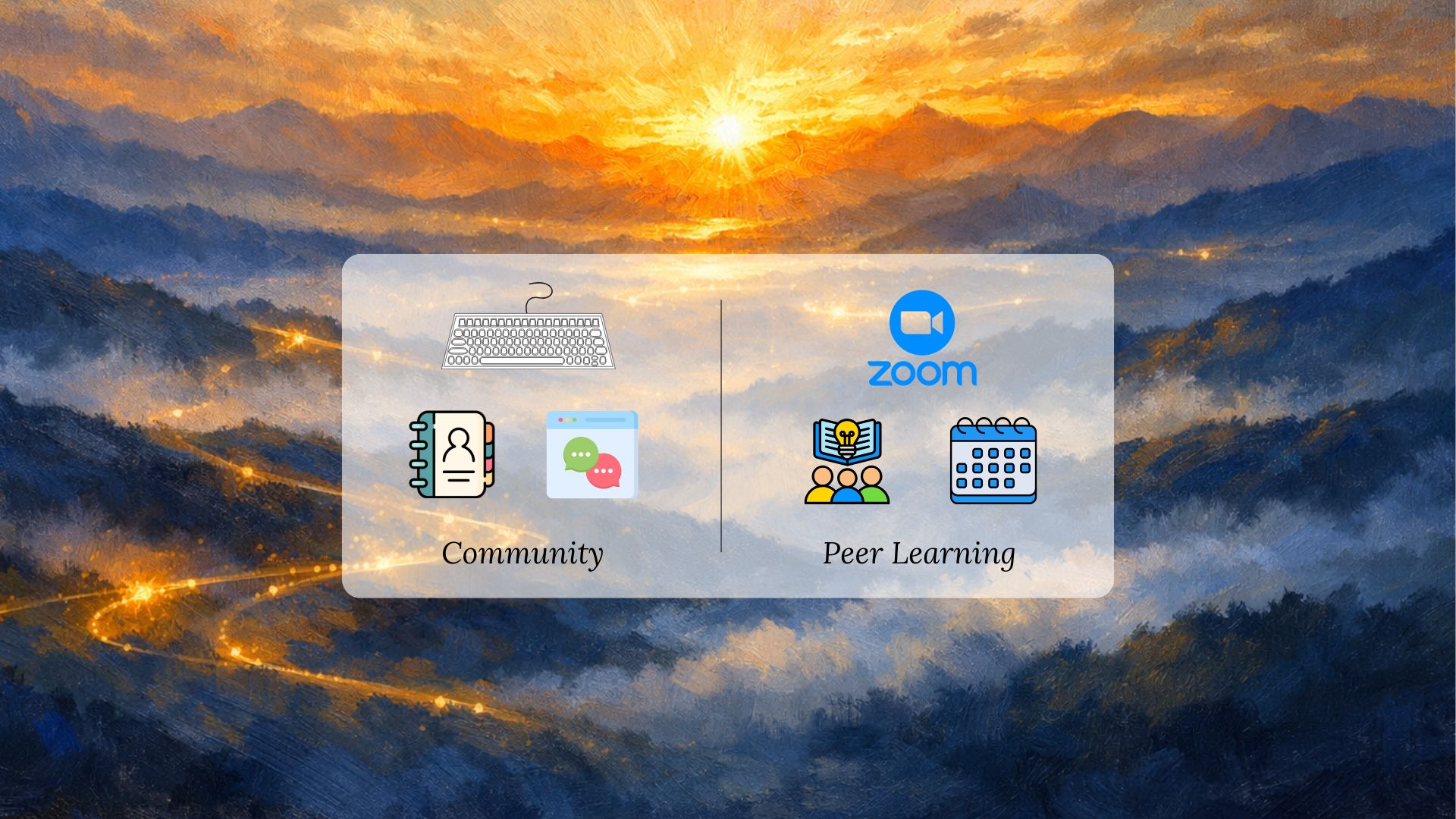
The pattern is clear. Traditional community platforms are strongest at hosting content and asynchronous discussion at scale. Peer learning platforms like RallyBoard are built for the harder problem: getting members into small groups, keeping them engaged between sessions, and proving the impact to leadership. Many mid-to-large associations run both, using a community platform as the always-on home base and a peer learning layer for high-engagement programming.
What the Right Features Actually Produce
Features only matter if they change outcomes. The numbers below come from published RallyBoard deployments and show what happens when matching, scheduling, and nudging are built in rather than bolted on.
Project Management Institute (PMI)
PMI, the world's largest project management association with 700,000+ members, launched the largest-scale mentoring program in its history on RallyBoard. In an initial 1.5-month pilot:
62 group meetings across multiple time zones
16,500+ minutes of live member engagement
57% average attendance rate, without manual staff follow-up
AI matching from intake data, with automated scheduling removing the logistics burden
Healthcare Financial Management Association (HFMA)
HFMA, serving 140,000 healthcare finance professionals, ran three program designs for different member segments. From September 2025 through January 2026:
16 unique cohorts across 3 program designs
60+ meetings and 18,000+ minutes of engagement
278 member-generated agenda topics via topic voting
Anonymized engagement trends gave the strategy team real-time visibility into member priorities
New American Colleges and Universities (NACU)
NACU, a consortium of 25+ institutions, revived dormant learning communities without adding staff. From a February 2025 pilot:
650+ member users across 24 active cohorts
2x increase in active community chairs, with members self-selecting
Over 50% feature adoption, expanding from 8 communities to all of them within months
The common thread: the features in Tier 2 and Tier 3 are what turned interest into attendance, and attendance into member intelligence.
Frequently Asked Questions
What features matter most in an association community platform?
Foundational features (forums, directory, content library, event integration) are table stakes that nearly every platform offers. The features that actually drive engagement are AI-powered matching, automated group scheduling, built-in video, behavioral nudging, and analytics tied to retention. Operationally, AMS integration, SSO, access gating, and privacy controls determine whether staff can deploy and secure the platform.
Why do most community platforms only engage a small share of members?
Open forums rely on members choosing to participate, which favors a vocal minority. Higher Logic's 2024 benchmarks put active participation around 15% within a 120-day period. Features like member matching, scheduled small-group meetings, and nudging address this by giving the other 85% a structured reason and rhythm to show up.
What is the difference between a community platform and a peer learning platform?
A community platform provides open, persistent spaces for asynchronous discussion and content sharing. A peer learning platform organizes members into small, matched groups with automated scheduling, facilitated agendas, and recurring meetings. Community platforms optimize for broad access; peer learning platforms optimize for deep, measurable engagement. Many associations use both.
Should the platform integrate with our AMS?
Yes. AMS integration is one of the most common technical blockers in association software. Ask which systems (Personify, iMIS, Fonteva, NetForum, and others) are supported natively, whether the sync pulls, pushes, or both, and how member-status checks and access gating work.
What privacy and legal features should associations require?
For regulated or litigation-sensitive fields, require opt-out recording, staff review before distribution, anonymized or generalized summaries rather than verbatim transcripts, moderation controls, and clear data-retention policies. Committee and peer conversations can be discoverable, and antitrust considerations may require staff oversight.
Does a small association need all of these features?
No single association needs every feature, but the engagement and operational tiers matter regardless of size. The automation that makes these platforms valuable at scale (matching, scheduling, nudging) is equally valuable for lean teams that lack dedicated staff for program coordination. NACU's 25-institution consortium is proof the model works well beyond the largest associations.
Bring This Checklist to Your Next Demo
The fastest way to separate a platform that will drive engagement from one that will not is to ask vendors to show you, live, how they handle the Tier 2 and Tier 3 features above. Anyone can show you a forum. Ask them to match a cohort, schedule a recurring meeting across time zones, and pull up cohort-level engagement analytics.
RallyBoard is purpose-built for the association market and works with organizations including PMI, HFMA, NACU, INFORMS, and AIIM. If you want to see the engagement and operational features in this checklist in action, book a demo.
Explore more guides
Review more playbooks on scaling member engagement
View all