Podcast
5 Lessons on Innovation from AGU's Trailblazing Technology Leader
AGU's SVP of Digital and Technology Thad Lurie explains why communication matters more than code, how associations can innovate without betting the farm, and why trust may be the most valuable asset your organization owns.

RallyBoard Staff
·
8 min read
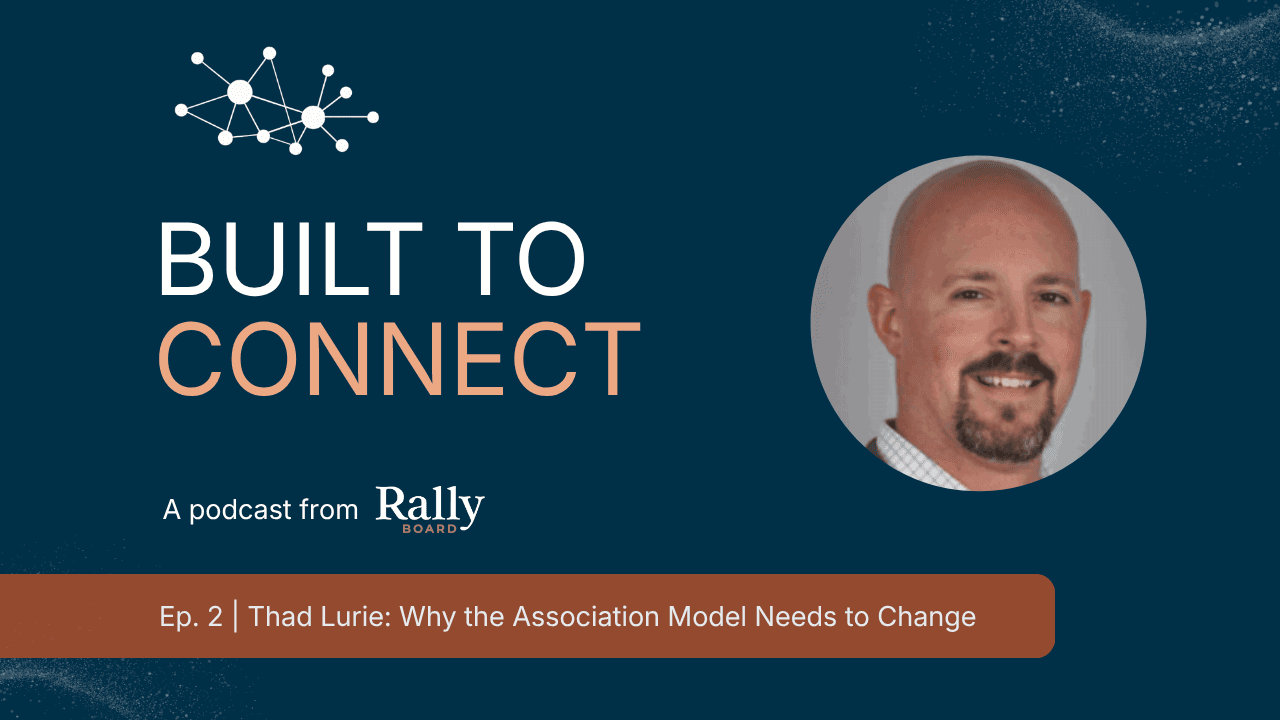
This post summarizes an episode of Built To Connect, RallyBoard's podcast featuring association leaders who are rethinking the business model. Our guest is Thad Lurie, SVP of Digital and Technology at the American Geophysical Union (AGU) and winner of the Association Trends Trailblazer Award.
Thad Lurie started his career as a first grade teacher. Today, he leads digital strategy and technology at AGU — a 130,000-person scientific community that publishes over twenty peer-reviewed journals and hosts one of the largest annual scientific meetings in the world. In between, he's held leadership roles at EDUCAUSE, American Health Law Association, American Wind Energy Association, and others.
That arc matters because Thad's perspective isn't shaped by one organization. It's shaped by decades of watching what actually works — and what doesn't — when associations try to change. And his framing is consistently more honest than what you typically hear on conference stages.
In our conversation on Built To Connect, Thad shared a view of association innovation that's both pragmatic and urgent. Here are five takeaways worth sitting with.
1. Technology Is a Commodity. Communication Is the Differentiator.
Thad's most contrarian take might also be his most important: the technology part of digital transformation is the easy part.
He referenced a remark from Reggie Henry at ASAE nearly a decade ago — that associations need to stop obsessing over the technology itself and focus instead on communication and collaboration. Thad's own experience bears this out. Whether it's replacing an AMS, launching AI features, or standing up a new website, the technical execution is doable. What makes or breaks the initiative is whether you brought people along.
"It doesn't matter how good your tech is. If the business does not adopt it or does not believe in it or will not go and sell it — it doesn't matter."
His approach: involve stakeholders from the beginning, not just at the demo. Share updates. Be transparent about what's working and what isn't. When you find a bug or discover a use case nobody anticipated, bring the team in rather than making a technical decision in a vacuum.
Editorial note: This resonates deeply with what we see at RallyBoard. The associations that succeed with new engagement programs aren't necessarily the ones with the most sophisticated tech stack — they're the ones where leadership has done the internal communication work to build buy-in. At NACU, the pilot worked because staff and volunteer leaders understood the vision before the platform launched. At PMI, early alignment on goals meant the team could iterate without second-guessing the premise. The pattern is consistent: communication precedes adoption.
2. Innovate in Bubbles, Not in Big Bangs
Associations aren't built for moonshots. Their governance structures favor consensus. Their boards are composed of practitioners, not venture capitalists. Their cultures lean toward risk aversion — and for understandable reasons: they exist to serve members, not to gamble with their trust.
Thad doesn't fight this reality. He works within it.
His model: small, contained proof-of-concept projects that test ideas without requiring a six-figure commitment. If something doesn't work, you let it go. If it does, you now have data, champions in the community, and a working product to justify the bigger investment.
"We're running small, contained risk, proof of concept type engagements that if something doesn't go well, okay, we let it go."
This approach has been successful enough that AGU's leadership proactively asked Thad's team to expand it — to run more projects through the same iterative, communicate-as-you-go framework.
Editorial note: The "fail fast" mantra swept through associations around 2015-2017, but Thad is right that it never fully stuck. The culture wasn't ready for it. What Thad describes is something more realistic: learn small. Test with a handful of members. Measure what matters. Then scale what works. This is exactly the pilot model we advocate for at RallyBoard — and what we've seen succeed with HFMA and PMI. The first cohort doesn't need to be perfect. It needs to generate enough signal to make the next decision with confidence.
3. The Association Value Proposition Is in Crisis — and That's an Opportunity
Thad didn't sugarcoat this one. When younger professionals can self-organize through Discord, group chats, and social platforms — when they walk around with an AirPod in, essentially in a continuous virtual conversation with their peer group — the traditional value proposition of "we bring people together" starts to weaken.
He described watching his own kids self-organize effortlessly. Then he connected that observation to the association model: if your primary value is convening people once a year, and emerging professionals already have tools to convene themselves, you have a problem.
"Some of the value proposition that we depended on in the eighties and nineties — I'm not sure it holds anymore."
AGU experienced this concretely: their 2024 Fall Meeting in DC drew over 30,000 attendees. The following year in New Orleans, that dropped to 21,000 — a 30% decline driven partly by funding cuts to science and complications around international travel under the current administration. When your business model depends heavily on a single annual gathering, a 30% hit is existential.
Editorial note: This tracks with what Marketing General's 2024 benchmarking data has been signaling for years — associations that concentrate their value proposition in a single annual event are increasingly vulnerable. The ones seeing sustained membership growth are investing in year-round engagement and multiple touchpoints. The annual meeting remains essential (Thad agrees), but it can't carry the full weight of the member relationship. We explored this in depth in our post on transforming 3 days of conference connection into 365 days of value.
4. Trust Is the Moat — and AI Makes It More Valuable, Not Less
This was Thad's most nuanced and forward-looking argument. In a world where AI generates plausible-sounding answers to almost any question, where disinformation proliferates across platforms, and where even sophisticated users struggle to distinguish reliable information from noise — the organizations that own trusted, peer-reviewed, rigorously validated content have an asset that is appreciating in value.
His framing: trust and identity.
"Are you gonna trust Claude? Or are you gonna trust the thing that was reviewed by seven independent scientists and verified to be accurate and true?"
He also cited a talk by Ken Holsinger of Freeman showing that Gen Z's most trusted content source isn't social media, YouTube, or news outlets. It's talking to someone in person — because you know they're real and you can look them in the eye.
Thad's synthesis: associations have both the trusted content (peer-reviewed publications, validated industry knowledge) and the trusted relationships (convened communities of real practitioners). In an era of AI-generated noise, this combination becomes more precious, not less.
Editorial note: This is where Thad's perspective and RallyBoard's thesis converge. We've long argued that associations can't win the content war — they'll never out-produce YouTube or out-deliver ChatGPT on convenience. But they can win the connection war, precisely because trust and curation can't be algorithmically replicated. What Thad adds is the content dimension: when your association's content is rigorously validated and your community is composed of real practitioners with shared professional identity, you have a moat that Big Tech simply cannot cross. The challenge is making that moat visible and accessible to members who default to Google first.
5. "Associations Worry Too Much About What Was and Not Enough About What Will Be"
Thad ended with a parable. Four monkeys in a room. A rope hanging from the ceiling with bananas at the top. Every monkey that tries to climb gets blasted with water, so eventually they all stop trying. One by one, the original monkeys are replaced with new ones. The new monkeys try to climb, but the others pull them down — even though none of them have ever experienced the water cannon themselves.
You end up with four monkeys who refuse to climb the rope, who stop each other from climbing the rope, and none of whom knows why.
"We need to pay a little more attention to the conditions. We need to be a little more willing to try climbing that rope, because things are changing really, really quickly in our environment."
His challenge to association leaders — especially senior ones — is to stop reflexively shutting down new ideas with "we tried that, it didn't work." Instead: "We tried that in 2006. Here's what happened. Do you think conditions might be ready for another try?"
Editorial note: This is the hardest takeaway to implement because it requires cultural change, not a budget line item. But it connects directly to everything else Thad described: the value proposition crisis, the 30% conference attendance drop, the emerging competitors for members' time and attention. The conditions have changed. The question is whether your organization's learned behaviors have caught up. If you're an association leader reading this and recognizing the monkey dynamic in your own organization, the prescription is straightforward: find a small, contained experiment. Communicate the vision. Measure the result. Let the data, not the institutional memory, make the case.
Final Thought
What makes Thad's perspective rare isn't that he's a technologist — there are plenty of those in the association world. It's that he's a technologist who understands that technology is the least interesting part of the transformation. Communication, culture, trust, and willingness to question inherited assumptions — those are the actual levers.
His parting observation is worth repeating: the reasons your association had for not trying something five years ago may no longer be valid. The environment has changed. The tools have changed. The member expectations have changed.
The only question is whether your organization will check.